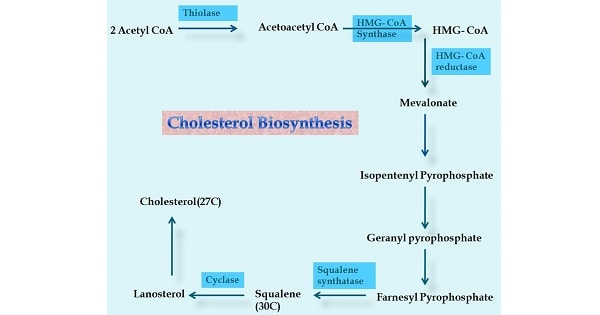
Cholesterol synthesis
The major step of regulation of cholesterol synthesis is:
| A |
Cyclization of squalene to lanosterol |
|
| B |
3-hydroxy-3-methylglutaryl-CoA synthase |
|
| C |
3-hydroxy-3-methylglutaryl-CoA lyase |
|
| D |
3-hydroxy-3-methylglutaryl-CoA reductase |
The major step of regulation of cholesterol synthesis is:
| A |
Cyclization of squalene to lanosterol |
|
| B |
3-hydroxy-3-methylglutaryl-CoA synthase |
|
| C |
3-hydroxy-3-methylglutaryl-CoA lyase |
|
| D |
3-hydroxy-3-methylglutaryl-CoA reductase |
Cholesterol is obtained from the diet as well as by de novo synthesis.
Although many cells can synthesize cholesterol, the liver is the major site of its production.
The rate of cholesterol production is highly responsive to feedback inhibition from both dietary cholesterol and synthesized cholesterol.
Feedback regulation is mediated by changes in the activity of 3-hydroxy-3-methylglutaryl-CoA reductase.
This enzyme is the first committed step in the production of cholesterol from acetyl-CoA.
3-Hydroxy-3-methylflutaryl-CoA, the substrate of the reductase, also can be synthesized into the ketone by acetoacetate by the action of 3-hydroxy-3-methylglutaryl-CoA lyase
Ref: Essentials of Medical Biochemistry; With Clinical Cases, 1st Ed, page 215
The first step in synthesis of steroids is derived from the cleavage of cholesterol. What is the enzyme responsible for the cleavage of 20,22-dehydrocholesterol to pregnenolone?
| A |
Delta 5-3 beta-hydroxysteroid dehydrogenase (3B – HSD) |
|
| B |
HMG-CoA reductase |
|
| C |
Aromatase |
|
| D |
17 alpha-hydroxylase |
The first step in synthesis of steroids is derived from the cleavage of cholesterol. What is the enzyme responsible for the cleavage of 20,22-dehydrocholesterol to pregnenolone?
| A |
Delta 5-3 beta-hydroxysteroid dehydrogenase (3B – HSD) |
|
| B |
HMG-CoA reductase |
|
| C |
Aromatase |
|
| D |
17 alpha-hydroxylase |
Which of the following enzymes is common to the synthesis of cholesterol and ketone bodies:
| A |
HMG -Co-A Reductase |
|
| B |
HMG-Co-A Lyase |
|
| C |
HMG-Co-A Synthase |
|
| D |
Thiokinase |
Which of the following enzymes is common to the synthesis of cholesterol and ketone bodies:
| A |
HMG -Co-A Reductase |
|
| B |
HMG-Co-A Lyase |
|
| C |
HMG-Co-A Synthase |
|
| D |
Thiokinase |
C i.e. HMG-Co-A Synthase


Which of the following blocks DNA replication with getting incorporated in DNA strand:
| A |
Cytarabine |
|
| B |
Nalidixic acid |
|
| C |
Ciprofloxacin |
|
| D |
Paclitaxel |
Which of the following blocks DNA replication with getting incorporated in DNA strand:
| A |
Cytarabine |
|
| B |
Nalidixic acid |
|
| C |
Ciprofloxacin |
|
| D |
Paclitaxel |
A i.e. Cytarabine
Cholesterol is synthesized from:
| A |
Acetyl CoA |
|
| B |
Alpha-ketoglutarate |
|
| C |
Glutaric acid |
|
| D |
Oxalate |
Cholesterol is synthesized from:
| A |
Acetyl CoA |
|
| B |
Alpha-ketoglutarate |
|
| C |
Glutaric acid |
|
| D |
Oxalate |
Cholesterol is:
| A |
Tocopherol |
|
| B |
Lipoprotein |
|
| C |
Steroid |
|
| D |
Lipopolysacchride |
Cholesterol is:
| A |
Tocopherol |
|
| B |
Lipoprotein |
|
| C |
Steroid |
|
| D |
Lipopolysacchride |
Cholesterol is an amphipathic lipid and is an important structural component of membranes and of the outer layer of plasma lipoproteins.
It is mainly synthesized in many tissues from Acetyl-CoA and is the precursor of all other steroids in the body, including corticosteroids, sex hormones, bile acids, and vitamin D.
Cholesterol is not a precursor of:
| A |
Bile acid |
|
| B |
Bile pigment |
|
| C |
Vitamin D |
|
| D |
Sex hormones |
Cholesterol is not a precursor of:
| A |
Bile acid |
|
| B |
Bile pigment |
|
| C |
Vitamin D |
|
| D |
Sex hormones |
Cholesterol is the precursor of bile acids [Bile contains bile salts (conjugated bile acids), which solubilize fats in the digestive tract and aid in the intestinal absorption of fat molecules as well as the fat-soluble vitamins, A, D, E, and K].
Mineral required for cholesterol biosynthesis ‑
| A |
Fe |
|
| B |
Mn |
|
| C |
Mg |
|
| D |
Cu |
Mineral required for cholesterol biosynthesis ‑
| A |
Fe |
|
| B |
Mn |
|
| C |
Mg |
|
| D |
Cu |
Mg is required in stage 2 of cholesterol synthesis.
Biosynthesis (De Novo Synthesis) of cholesterol
- The liver is the major site for cholesterol biosynthesis. Some cholesterol is also synthesized in intestine adre‑nal cortex, gonads and skin. The microsomal (smooth endoplasmic reticulum) and cytosol fraction of cell is responsible fir cholesterol synthesis; However most of the reactions in synthesis occurs in cytosol.
- Cholesterol is a C-27 compound. All 27-carbon atoms of cholesterol are derived from a single precursor, i.e. acetyl-CoA (activated acetate).
- First two molecules of acetyl-CoA condense to form acetoacetyl-CoA. Next, a third molecule of acetyl- CoA condenses with acetoacetyl-CoA to form 3-hydroxy-3-methylglutaryl-CoA (HMG-CoA). Then HMG-CoA is converted to mevalonate by HMG-CoA reductase, the key regulatory enzyme of cholesterol synthesis.
Rate limiting step in cholesterol synthesis –
| A |
HMG CoA reductase |
|
| B |
HMG CoA synthase |
|
| C |
Mevalonate kinase |
|
| D |
Squalene synthetase |
Rate limiting step in cholesterol synthesis –
| A |
HMG CoA reductase |
|
| B |
HMG CoA synthase |
|
| C |
Mevalonate kinase |
|
| D |
Squalene synthetase |
Ans. is ‘a’ i.e., HMG Co A reductase
| Reactions | Rate limiting enzymes |
| Glycolysis | Phosphofructokinase |
| Glycogen synthesis | Glycogen synthetase |
|
Glycogenolysis |
Glycogen phosphorylase |
|
TCA cycle |
Isocitrate dehydrogenase |
| Fatty acid synthesis | Acetyl CoA carboxylase |
| Cholesterol synthesis | HMG CoA reductase HMG |
| Ketone body synthesis | CoA synthase |
| Bile acid synthesis | 7-a-hydroxylase |
| Catecholamine synthesis | Tyrosine hydroxylase |
| Urea synthesis |
Carbamoyl transferase |