
ENZYME INHIBTION
The presence of a noncompetitive inhibitor can be implicated in which of the outcome?
| A |
Leads to both an increase in the Vmax of a reaction and an increase in the Km |
|
| B |
Leads to a decrease in the observed Vmax |
|
| C |
Leads to a decrease in Km and Vmax |
|
| D |
Leads to an increase in Km without affecting Vmax |
The presence of a noncompetitive inhibitor can be implicated in which of the outcome?
| A |
Leads to both an increase in the Vmax of a reaction and an increase in the Km |
|
| B |
Leads to a decrease in the observed Vmax |
|
| C |
Leads to a decrease in Km and Vmax |
|
| D |
Leads to an increase in Km without affecting Vmax |
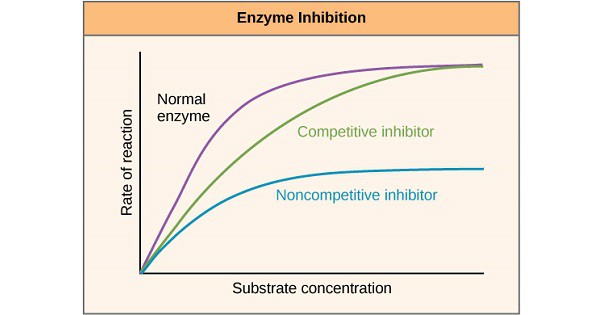
In the presence of a noncompetitive inhibitor, Vmax is decreased, whereas Km is unchanged. The steady-state concentration of ES is decreased.
A competitive inhibitor of an enzyme will?
| A |
Alter the Vmax of the reaction |
|
| B |
Bind to the same site as the substrate |
|
| C |
Decrease the apparent Km for the substrate |
|
| D |
Decrease the turnover number |
A competitive inhibitor of an enzyme will?
| A |
Alter the Vmax of the reaction |
|
| B |
Bind to the same site as the substrate |
|
| C |
Decrease the apparent Km for the substrate |
|
| D |
Decrease the turnover number |
Substances that reduce the activity of an enzyme are called inhibitors.
Reversible inhibitors bind to an enzyme but rapidly dissociate from it [in contrast to irreversible inhibitors , which bind tightly and dissociate very slowly from the enzyme].
There are several types of reversible inhibitors:
True about competitive inhibition of enzyme:
| A |
T Km |
|
| B |
Km |
|
| C |
T Vmax |
|
| D |
No change in Km and Vmax |
True about competitive inhibition of enzyme:
| A |
T Km |
|
| B |
Km |
|
| C |
T Vmax |
|
| D |
No change in Km and Vmax |

In noncompetitive antagonism, the true statement is:
| A |
Km value decrease; V max normal |
|
| B |
Km value decreased; V max decreased |
|
| C |
Km value normal; V max decreased |
|
| D |
Km value decreased; V max increased |
In noncompetitive antagonism, the true statement is:
| A |
Km value decrease; V max normal |
|
| B |
Km value decreased; V max decreased |
|
| C |
Km value normal; V max decreased |
|
| D |
Km value decreased; V max increased |
Non competitive inhibitor of carbonic anhydrase‑
| A |
Allopurinol |
|
| B |
Acetazolamide |
|
| C |
Bimatoprost |
|
| D |
Dipivefrine |
Non competitive inhibitor of carbonic anhydrase‑
| A |
Allopurinol |
|
| B |
Acetazolamide |
|
| C |
Bimatoprost |
|
| D |
Dipivefrine |
Ans. is ‘b’ i.e., Acetazolamide
o Acetazolamide is non-competitive , reversible inhibitor of carbonic anhydrase.
Which of the following is known as suicidal enzyme?
| A |
Lipoxygenase |
|
| B |
Cyclooxygenase |
|
| C |
Thromboxane synthatase |
|
| D |
5′ nucleotidase |
Which of the following is known as suicidal enzyme?
| A |
Lipoxygenase |
|
| B |
Cyclooxygenase |
|
| C |
Thromboxane synthatase |
|
| D |
5′ nucleotidase |
Suicidal enzyme is one, which undergoes self-destruction in order to terminate its own acitivity, e.g. Cyclooxygenase.
Suicidal Inhibition is conversion of a substrate by the enzyme into a metabolite, which is a potent inhibitor of the enzyme; example: Xanthine oxidase converts allopurinol to alloxanthine (oxypurinol), which is a more potent inhibitor of allopurinol.

