


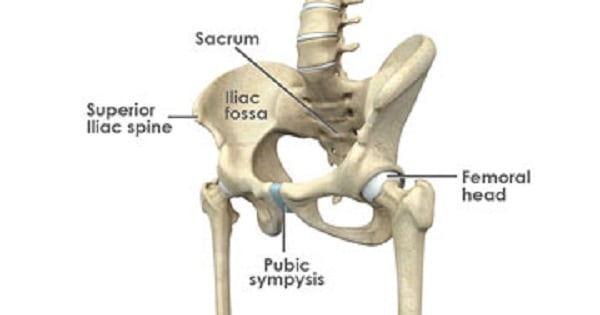
HIP JOINT
Which of the following muscle helps in the flexion of hip joint?
| A |
Psoas |
|
| B |
Piriformis |
|
| C |
Pectoralis major |
|
| D |
External oblique abdominis |
Which of the following muscle helps in the flexion of hip joint?
| A |
Psoas |
|
| B |
Piriformis |
|
| C |
Pectoralis major |
|
| D |
External oblique abdominis |
Flexors of hip: Psoas major and illiacus are the chief flexors of hip joint. Pectineus, rectus femoris, adductors and sartorius are the accessory muscles. Adductors mainly the adductor longus participate in the early stages of flexion.
Which of the ligaments limits extension at the hip joint?
| A |
Iliofemoral |
|
| B |
Ligamentum capitis femoris |
|
| C |
Pubofemoral |
|
| D |
Zona orbicularis |
Which of the ligaments limits extension at the hip joint?
| A |
Iliofemoral |
|
| B |
Ligamentum capitis femoris |
|
| C |
Pubofemoral |
|
| D |
Zona orbicularis |
The iliofemoral ligament is a Y-shaped ligament extending from the anterior inferior iliac spine to the anterior surface of the intertrochanteric line of the femur. It prevents hyperextension of the hip joint during standing by screwing the femoral head into the acetabulum. (The ischiofemoral ligament also helps to prevent hyperextension of the hip joint by screwing the femoral head into the acetabulum).
Ligamentum capitis femoris attaches the head of the femur to the acetabular fossa. The pubofemoral ligament connects the pubic portion of the rim of the bony acetabulum to the medial surface of the femoral neck. It prevents over abduction of the hip joint.
Zona orbicularis is a band of circularly oriented ligamentous fibers that reinforce the capsule of the hip joint. it helps keep the head of the femur in its socket.
Bigelow’s ligament is at
| A |
Knee joint |
|
| B |
Shoulder joint |
|
| C |
Hip joint |
|
| D |
Ankle joint |
Bigelow’s ligament is at
| A |
Knee joint |
|
| B |
Shoulder joint |
|
| C |
Hip joint |
|
| D |
Ankle joint |
C. i.e. Hip joint
True regarding the hip joint is :
| A |
Medial rotation and Abduction is caused by Gluteus medius and Gluteus minimus |
|
| B |
Medial rotation and Adduction is caused by Gluteus medius and Gluteus minimus |
|
| C |
Lateral rotaters of thigh are supplied by femoral nerve |
|
| D |
Hyperextension of Hip is prevented by capsular thickening |
A i.e. Medial rotation & abduction is caused by gluteus medius & minimus
Gluteus medius & minimus are powerful abductors of hip & also cause medial rotation (not lateral rotation). Gluteus maximus is extensor & lateral rotator of hip.
Sartorius is flexor, abductor & lateral rotator of hip & flexes knee joint. (i.e. palthi posture/ sitting crossed leg / position in which tailors sit).
Tensor fascia lata is flexor, abductor & medial rotator of hip; helps in knee extension.
Hyper extension is prevented by iliofemoral ligament (Ligament of Bigelow) not by capsular thickening
Femoral nerve (L2L3L4) supplies flexor muscles of hip (anterior compartment of thigh) i.e. – Sartorius, Quadriceps femoris (rectus femoris + vastus laterlis, medialis & intermedius), articularis genu not lateral rotators of thigh (eg. Gluteus maximus)
Ligament resisting hyperextension of hip are all except:
| A |
Ischiofemoral ligament |
|
| B |
Pubofemoral ligament |
|
| C |
Iliofemoral ligament |
|
| D |
Sacroiliac ligament |
Ligament resisting hyperextension of hip are all except:
| A |
Ischiofemoral ligament |
|
| B |
Pubofemoral ligament |
|
| C |
Iliofemoral ligament |
|
| D |
Sacroiliac ligament |
Ans. D: Sacroiliac ligament
When the knee is flexed, flexion is limited by the anterior surface of the thigh coming into contact with the anterior abdominal wall.
When the knee is extended, flexion is limited by the tension of the hamstring group of muscles.
Extension, which is the movement of the flexed thigh backward to the anatomic position, is limited by the tension of the iliofemoral, pubofemoral, and ischiofemoral ligaments.
Abduction is limited by the tension of the pubofemoral ligament, and adduction is limited by contact with the opposite limb and by the tension in the ligament of the head of the femur.
Lateral rotation is limited by the tension in the iliofemoral and pubofemoral ligaments, and medial rotation is limited by the ischiofemoral ligament.
The following movements take place:
- Flexion is performed by the iliopsoas, rectus femoris, and sartorius and also by the adductor muscles.
- Extension (a backward movement of the flexed thigh) is performed by the gluteus maximus and the hamstring muscles.
- Abduction is performed by the gluteus medius and minimus, assisted by the sartorius, tensor fasciae latae and piriformis.
Adduction is performed by the adductor longus and brevis and the adductor fibers of the adductor magnus. These muscles are assisted by the pectineus and the gracilis.
Lateral rotation is performed by the piriformis, obturator internus and externus, superior and inferior gemelli, and quadratus femoris, assisted by the gluteus maximus.

