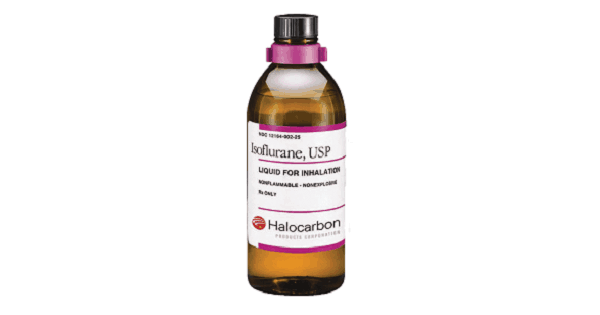
Isoflurane
Which of the following is the anaesthetic agent of choice in renal failure?
| A |
Isoflurane |
|
| B |
Enflurane |
|
| C |
Methoxyflurane |
|
| D |
None of the above |
Which of the following is the anaesthetic agent of choice in renal failure?
| A |
Isoflurane |
|
| B |
Enflurane |
|
| C |
Methoxyflurane |
|
| D |
None of the above |
Isoflurane is the anaesthetic drug of choice in renal failure.
It is useful in all degrees of renal impairment.
Due to minimal hepatic metabolism resulting in very low levels of inorganic fluorides and
because of its low cardiac arrythmogenicity isoflurane is an ideal agent for patients with renal failure.
Ref: Drug Dosage in Renal Insufficiency By G. Seyffart, Page 313 ; Meyler’s Side Effects of Drugs Used in Anesthesia By Jeffrey K. Aronson, Page 19 ; Foye’s Principles of Medicinal Chemistry By William O. Foye, 6th Edition, Page 500
Which inhalational agent is used in patients with raised intra cranial tension?
| A |
Enflurane |
|
| B |
Isoflurane |
|
| C |
Desflurane |
|
| D |
Sevoflurane |
Which inhalational agent is used in patients with raised intra cranial tension?
| A |
Enflurane |
|
| B |
Isoflurane |
|
| C |
Desflurane |
|
| D |
Sevoflurane |
Isoflurane causes least vasodialation and hence helps to moderate the cerebral blood flow.
It reduces the ICT and hence is useful in neurosurgery.
It is more potent than halothane and has rapid onset of action and induction.
Reference
1. Quick Review of Pharmacology, By Dr J G Buch, Page 204
Pungent volatile anesthetic agents are:
| A |
Halthane |
|
| B |
Isoflurane |
|
| C |
Sevoflurane |
|
| D |
Desflurane |
Pungent volatile anesthetic agents are:
| A |
Halthane |
|
| B |
Isoflurane |
|
| C |
Sevoflurane |
|
| D |
Desflurane |
B i.e. Isoflurane
Fluoride content is least:
| A |
Methoxyflurane |
|
| B |
Enflurane |
|
| C |
Isoflurane |
|
| D |
Sevoflurane |
Fluoride content is least:
| A |
Methoxyflurane |
|
| B |
Enflurane |
|
| C |
Isoflurane |
|
| D |
Sevoflurane |
C i.e. Isoflurane
Isoflurane has least & methoxyflurane has highest fluride contentQ. Methoxyflurane causes vasopressin resistant high output renal failure.Q.
In increased ICT, agent used for anesthesia
| A |
N20 |
|
| B |
Trilene |
|
| C |
Ether |
|
| D |
Isoflurane |
In increased ICT, agent used for anesthesia
| A |
N20 |
|
| B |
Trilene |
|
| C |
Ether |
|
| D |
Isoflurane |
D i.e. Isoflurane
Least effect on myocardial contractility
| A |
Ether |
|
| B |
Halothane |
|
| C |
Trilene |
|
| D |
Isoflurane |
Least effect on myocardial contractility
| A |
Ether |
|
| B |
Halothane |
|
| C |
Trilene |
|
| D |
Isoflurane |
Ans:D i.e. Isoflurane.
CARDIAC EFFECTS OF ANESTHETIC AGENTS :
Anticholinergic agents – Atropine/glycopyrrolate: will cause an increase in heart rate, contractility, cardiac output and myocardial oxygen consumption. Often there will be no change
in blood pressure and a decrease in right atrial pressure.
Thiopental – Barbiturate
Reduction in blood pressure – peripheral vasodilation is the main action. Compensatory rise in heart rate – barorecptor response. Commonly associated with ventricular arrhythmias .
Benzodiazepines
Midazolam and diazepam: Cause little or no direct myocardial depressant effects.
Hypnotics- Etomidate: no direct myocardial depression. Safe to use with cardiac, critical and septic patients. .
Mu opioids– Fentanyl is a pure mu agonist causes dose dependant bradycardia (increase in vagal tone).
Mixed agonist/antagonist agents= Buprenorphine: a partial mu agonist/antagonist. Slow onset of action, duration of 6-8 hours.
Cardiovascular depression and respiratory depression not as profound as pure mu agonists. Butorphanol: partial agonist/antagonist. Similar to buprenorphine in cardiovascular/respiratory effects.
Dissociative Agents:Ketamine- Heart rate and arterial pressure increase due to an increase in sympathetic tone .
Inhalational Anesthetics:
- Isoflurane and sevoflurane preserved cardiac index, and isoflurane and fentanyl-midazolam preserved myocardial contractility at baseline levels in this group of patients with congenital heart disease.
- Halothane depressed cardiac index and myocardial contractility.
Least Cardiotoxic anaesthetic agent
| A |
Enflurane |
|
| B |
Isoflurane |
|
| C |
Sevoflurane |
|
| D |
Halothane, Trilene, ketamine |
Least Cardiotoxic anaesthetic agent
| A |
Enflurane |
|
| B |
Isoflurane |
|
| C |
Sevoflurane |
|
| D |
Halothane, Trilene, ketamine |
B i.e. Isoflurane
Isoflurane increases ICT but less than halothane & enflurane; which can be reversed by hyperventilation. So isoflurane is a preferable agent in raised ICT. Isoflurane is anaesthesia of choice (AOC) for neurosurgical procedureQ as it does not increase cerebral blood flow & CSF pressure.
Of various inhalation agents available, isoflurane has the advantage of providing stability of cardiac rhythm & lack of sensitizention of the heart to exogenous & endogenous adrenalineQ.
In coronary artery disease isoflurane should be avoided Wt coronary steel phenomenonQ.
In ischemia of cardiac muscle selective vasodialation of vessels of Ischemic zone and maintained tone of non ischemic zone //t selective increase of blood supply to ischemic areas.
But in coronary steal phenomenon (Isoflurane & Dipyridomole) there is dialation of vessels of non ischemic zone also so there is decrease of flow in ischemic zone.Q That is why isoflurane is avoided in ischemic heart disease.
- In Myocardial Infarction operation should be with held for 6 monthsQ.
- Goldman Index is for cardiac risk factor and when it is > 13 it is associated with poor prognosis.
- In hypertension, halothane is AOC (for hypotensive surgery)
In hypovolumia, Light G.A. (preferably Ether and Cyclopropane) with IPPV is method of choice
Isoflurane increases ICT but less than halothane & enflurane; which can be reversed by hyperventilation. So isoflurane is a preferable agent in raised ICT. Isoflurane is anaesthesia of choice (AOC) for neurosurgical procedureQ as it does not increase cerebral blood flow & CSF pressure.
Of various inhalation agents available, isoflurane has the advantage of providing stability of cardiac rhythm & lack of sensitizention of the heart to exogenous & endogenous adrenalineQ.
In coronary artery disease isoflurane should be avoided Wt coronary steel phenomenonQ.
In ischemia of cardiac muscle selective vasodialation of vessels of Ischemic zone and maintained tone of non ischemic zone //t selective increase of blood supply to ischemic areas.
But in coronary steal phenomenon (Isoflurane & Dipyridomole) there is dialation of vessels of non ischemic zone also so there is decrease of flow in ischemic zone.Q That is why isoflurane is avoided in ischemic heart disease.
- In Myocardial Infarction operation should be with held for 6 monthsQ.
- Goldman Index is for cardiac risk factor and when it is > 13 it is associated with poor prognosis.
- In hypertension, halothane is AOC (for hypotensive surgery)
In hypovolumia, Light G.A. (preferably Ether and Cyclopropane) with IPPV is method of choice
Which of the following statements regard-ing desflurane is correct?
| A |
It causes severe myocardial depression |
|
| B |
It is a structural analogue of isoflurane |
|
| C |
It has vary high blood and tissue gas partition coefficients |
|
| D |
It is metabolically unstable |
Which of the following statements regard-ing desflurane is correct?
| A |
It causes severe myocardial depression |
|
| B |
It is a structural analogue of isoflurane |
|
| C |
It has vary high blood and tissue gas partition coefficients |
|
| D |
It is metabolically unstable |
B i.e. It is a structural analogue of isoflurane
Desflurane’s structure is very similar to that of isoflurane. The only difference is substitution of a fluride atom for isofluranes chlorine atom. Q
The following combination of agents are the most preferred for short day care surgeries
| A |
Propofol, fentanyl, isoflurane |
|
| B |
Thiopentone sodium, morphine, halothane |
|
| C |
Ketamine, pethidine, halothane |
|
| D |
Propofol, morphine, halothane |
The following combination of agents are the most preferred for short day care surgeries
| A |
Propofol, fentanyl, isoflurane |
|
| B |
Thiopentone sodium, morphine, halothane |
|
| C |
Ketamine, pethidine, halothane |
|
| D |
Propofol, morphine, halothane |
A i.e. Propofol, Fentanyl, isoflurane
A 52 year old male diagnosed as triple vessel coronary artery disease with poor left ventricular function. Coronary artery bypass grafting surgery was decided. During maintenance of anaesthesia which one of the following agents should be preferred?
| A |
IV Opioids |
|
| B |
Isoflurane |
|
| C |
Halothane |
|
| D |
a and b |
A 52 year old male diagnosed as triple vessel coronary artery disease with poor left ventricular function. Coronary artery bypass grafting surgery was decided. During maintenance of anaesthesia which one of the following agents should be preferred?
| A |
IV Opioids |
|
| B |
Isoflurane |
|
| C |
Halothane |
|
| D |
a and b |
A i.e. Opioids > B i.e. Isoflurane
Anaesthesia in ischemic heart disease
Induction agents
– Propofol, barbiturate, etomidate, benzodiazepines, opioids & combinations are used
Ketamine is relatively contraindicated because its indirect sympathominetic effect can adversely affect the myocardial oxygen demand-supply balance. When combined with a benzodiazepine or propofol, however, ketamine does not appreciably increase sympathetic activity and results in relatively stable hemodynamics with minimal myocardial depression. The combination of benzodiazepine and ketamine may be most useful in patient with poor ventricular function (ejection fraction <30%) and in frail patient with hemodynamic compromise.
High dose opioid anesthesia had previously been used widely for patients with significant ventricular dysfunction4. With the exception of meperidine (in large doses), opioids alone are generally associated with minimal or no cardiac depression. Apparent cardiac depression may also occur wth pure high dose opioid inductions : this likely represents withdraw of an elevated baseline sympathetic tone. Patients with poor ventricular function often rely on an elevated sympathetic tone to maintain their cardiac output & may decompensate even with pure high dose opioid anaesthesia. (That’s why now mixed I.V & inhalation anaesthesia is used)
Maintenance agents
– Patients are generally managed with n opioid-volatile anaesthetic technique – Patients with ejection fraction < 40% may be very sensitive to the depressant effects of potent volatile agents or large bolus of opioids
– N20, Particularly in presence of opioids, can also produce significant cardiac depression
– All volatile agents generally have favorable effect on myocardial oxygen balance, reducing demand more than supply. Isoflurane dilates intramyocardial arteries more than the larger epicardial vessels but there is little evidence that isoflurane causes an intracoronary steal phenomenon in clinical practice.
A patient of alcohlic liver faliure requires general anesthesia AOC is
| A |
Ether |
|
| B |
Halothane |
|
| C |
Isoflurane |
|
| D |
Methoxyflurane |
A patient of alcohlic liver faliure requires general anesthesia AOC is
| A |
Ether |
|
| B |
Halothane |
|
| C |
Isoflurane |
|
| D |
Methoxyflurane |
C i.e. Isoflurane
– IsofluraneQ is volatile anesthetic agent of choiceQ in patients with liver disease because it has the least effect on hepatic blood flow.
– CisatracuriumQ is neuromuscular blocking agent of choiceQ owing to its unique non hepatic metabolism.
Anesthesia of choice in renal failure
| A |
Methoxy flurane |
|
| B |
Isoflurane |
|
| C |
Enflurane |
|
| D |
None |
Anesthesia of choice in renal failure
| A |
Methoxy flurane |
|
| B |
Isoflurane |
|
| C |
Enflurane |
|
| D |
None |
B i.e. Isoflurane
A patient posted for surgery has raised intracranial tension. Which of the following anesthetics would be preferred in him?
| A |
Enflurane |
|
| B |
Sevoflurane |
|
| C |
Isoflurane |
|
| D |
Desflurane |
A patient posted for surgery has raised intracranial tension. Which of the following anesthetics would be preferred in him?
| A |
Enflurane |
|
| B |
Sevoflurane |
|
| C |
Isoflurane |
|
| D |
Desflurane |
Ans. c. Isoflurane