
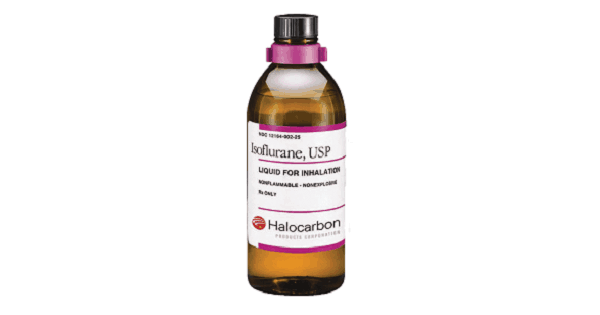
Isoflurane
ISOFLURANE
- An isomer of enflurane & desflurane.
- Mild pungent odour.
- Isoflurane – Pungent volatile anaesthetic agent,
- Colourless.
- Less soluble.
- Nonflammable.
- Stable.
- Rapid and smooth induction.
- MAC – 1.5%
ACTIONS:
Heart:
- Lesser effects.
- Does not sensitize heart to catecholamines.
- Hence, safe in pheochromocytoma.
- Isoflurane has least cardiotoxic –
- Due to least effect on myocardial contractility.
Muscle:
- Adequate muscle relaxation.
USES:
- Inhalational agent of choice for producing controlled hypotension.
- Produces maximum decrease in BP.
- Ideal agent for patients with renal failure.
- Least cardiotoxic.
- Due to low cardiac arrhythmogenicity.
- Anaesthesia of choice (AOC) for neuro-surgical procedure.
- Preferred as an inhalational agent in patients with raised intracranial tension.
- Because does not increase cerebral blood flow & CSF pressure.
- Used for achieving anaesthesia maintenance in CABG.
- Alcoholic liver failure requires GA.
- Due to minimal hepatic metabolism.
- Resulting in very low levels of inorganic fluorides.
- Used safely in pheochromocytoma
- Does not sensitize heart to catecholamines.
ADVERSE EFFECT:
- In CAD – Due to “Coronary steal phenomenon”.
- Causes vessel dilatation of non-ischemic zone.
- Also decreases flow to ischemic zone.
- Hence, avoided in IHD.
Exam Question
- Isoflurane is the anaesthetic agent of choice in renal failure.
- Isoflurane as an inhalational agent is used in patients with raised intracranial tension.
- Isoflurane is a pungent volatile anaesthetic agent.
- Fluoride content is least in Isoflurane
- Isoflurane has the least effect on myocardial contractility & is least cardiotoxic.
- Desflurane is a structural analogue of isoflurane
- In Coronary artery bypass grafting (CABG) surgery maintenance of anaesthesia is achieved by Isoflurane
- Alcoholic liver failure requires general anaesthesia AOC isoflurane.
Don’t Forget to Solve all the previous Year Question asked on Isoflurane
