


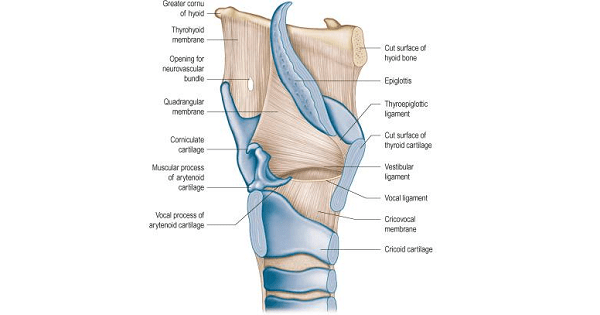
LIGAMENTS OF LARYNX & EPIGLOTTIS
Most common site in larynx for sarcoidosis is:
| A |
Epiglottis |
|
| B |
Vocal cord |
|
| C |
Cartilage |
|
| D |
None of the above |
Most common site in larynx for sarcoidosis is:
| A |
Epiglottis |
|
| B |
Vocal cord |
|
| C |
Cartilage |
|
| D |
None of the above |
One to five percent of patients with sarcoidosis present with lesions within the larynx. The epiglottis is the most common site of involvement.
Epithelial lining of lingual surface of epiglottis is?
| A |
simple squamous epithelium |
|
| B |
Simple Cuboidal |
|
| C |
Pseudostratified ciliated columnar |
|
| D |
Stratified squamous epithelium |
Epithelial lining of lingual surface of epiglottis is?
| A |
simple squamous epithelium |
|
| B |
Simple Cuboidal |
|
| C |
Pseudostratified ciliated columnar |
|
| D |
Stratified squamous epithelium |
The lingual surface of the epiglottis and the true vocal cords are lined by stratified squamous epithelium.
Epiglottis has a lingual and laryngeal surface. The laryngeal surface is lined by pseudostratified ciliated columnar epithelium. Beneath this epithelium in the lamina propria on the laryngeal side of the epiglottis, there are abundant tubuloacinar seromucous glands.
Which of the following is MOST important in separating the esophagus from the larynx, and must consequently be carefully passed behind during endoscopy?
| A |
Arytenoids |
|
| B |
Cricoid cartilage |
|
| C |
Epiglottis |
|
| D |
Pharynx |
Which of the following is MOST important in separating the esophagus from the larynx, and must consequently be carefully passed behind during endoscopy?
| A |
Arytenoids |
|
| B |
Cricoid cartilage |
|
| C |
Epiglottis |
|
| D |
Pharynx |
Endoscopists are very careful when guiding the endoscope past the epiglottis, which is a pear-shaped portion of elastic cartilage that can be moved during swallowing to close the larynx, preventing swallowed material from eventually entering the lungs.
- The arytenoids are the site of the attachment of the vocal cords within the larynx.
- The cricoid cartilage is in the more distal portion of the larynx.
- The pharynx is shared by the respiratory and gastrointestinal tracts.
- The thyroid cartilage forms a median elevation, called the laryngeal prominence (“Adam’s apple”), and lies inferior to the hyoid bone.
- The epiglottis is an elastic cartilage, shaped like a spoon, that is posterior to the root of the tongue.
- The cricoid cartilage is shaped like a signet ring, with the broad part of the ring facing posteriorly.
- The arytenoid cartilages are shaped like a pyramid.
Which of the following pharyngeal arches develops into epiglottis?
| A |
1st pharyngeal arch |
|
| B |
2nd pharyngeal arch |
|
| C |
4th pharyngeal arch |
|
| D |
3rd pharyngeal arch |
Which of the following pharyngeal arches develops into epiglottis?
| A |
1st pharyngeal arch |
|
| B |
2nd pharyngeal arch |
|
| C |
4th pharyngeal arch |
|
| D |
3rd pharyngeal arch |
| Pharyngeal arch | Muscular contributions | Skeletal contributions | Nerve | Artery |
| 1st (also called “mandibular arch”) | Muscles of mastication, anterior belly of the digastric, mylohyoid, tensor tympani, tensor veli palatini | Maxilla, mandible (only as a model for mandible not actual formation of mandible), the incus and malleus of the middle ear, also Meckel’s cartilage | Trigeminal nerve(V2 and V3) | Maxillary artery, external carotid artery |
| 2nd (also called the “hyoid arch”) | Muscles of facial expression, buccinator, platysma, stapedius, stylohyoid, posterior belly of the digastric | Stapes, styloid process, hyoid (lesser horn and upper part of body), Reichert’s cartilage | Facial nerve (VII) | Stapedial artery, hyoid artery |
| 3rd | Stylopharyngeus | Hyoid (greater horn and lower part of body), thymus, inferior parathyroids | Glossopharyngeal nerve (IX) | Common carotid, internal carotid |
| 4th | Cricothyroid muscle, all intrinsic muscles of soft palate including levator veli palatini | Thyroid cartilage, superior parathyroids, epiglottic cartilage | Vagus nerve (X), superior laryngeal nerve |
Right 4th aortic arch: subclavian artery
Left 4th aortic arch: aortic arch
|
| 6th | All intrinsic muscles of larynx except the cricothyroid muscle | Cricoid cartilage, arytenoid cartilages, corniculate cartilage | Vagus nerve (X), recurrent laryngeal nerve |
Right 6th aortic arch: pulmonary artery
Left 6th aortic arch: pulmonary artery and ductus arteriosus
|
Ref: Langman Embryology, 11 Edition, pg. 277
True about upper airways of neonate-
| A |
Cricoid is narrowest part |
|
| B |
Larynx extend from C4 to C6 |
|
| C |
Epiglottis is big & omega shaped |
|
| D |
All |
True about upper airways of neonate-
| A |
Cricoid is narrowest part |
|
| B |
Larynx extend from C4 to C6 |
|
| C |
Epiglottis is big & omega shaped |
|
| D |
All |
Ans. is ‘c’ i.e., Epiglottis is big & omega shaped
Anatomy of airway in neonate
The anatomy of the upper airway predisposes to obstruction. Its characteristic features are
o Proportionately larger head and tongue, the tongue is often pushed against the palate
o Narrow nasal passages
o Anterior and cephalad larynx (the larynx is anteriorly inclined)
o Epiglottis is soft, large and patulous, Omega shaped and inclined at 45°.
- The Subglottic region rather than the rima glottidis is the narrowest portion of the airway.
- Vocal cord is at the level of C,
- Trachea bifurcates at the level of T2
o Larynx lies opposite Pd, 3′d and 4th cervical vertebra at birth.
True about larynx in neonate:
| A |
Epiglottis is large and omega shaped |
|
| B |
Cricoid narrowest part |
|
| C |
It extends till C4,5,6 vertebrae |
|
| D |
a and b |
True about larynx in neonate:
| A |
Epiglottis is large and omega shaped |
|
| B |
Cricoid narrowest part |
|
| C |
It extends till C4,5,6 vertebrae |
|
| D |
a and b |
Infant’s Larynx Differs from Adult in:
1. It is situated high up (C2 – C4).° (in adults = C3 – C6)
2. Of equal size in both sixes (in adults it is larger in males)
3. Larynx is funnel shaped
4. The narrowest part of the infantile larynx is the junction of subglottic larynx with trachea and this is because cricoid cartilage is very small
5. Cartilages:
- Epiglottis is omega shaped, soft, large and patulous.
- Laryngeal cartilages are soft and collapse easily
- Thyroid cartilage is flat
- Arytenoid cartilage is relatively large
6. The cricothyroid and thyrohyoid spaces are narrow
7. The submucosal tissue is thick and loose and becomes oedematous in response to inflammation
8. Vocal cords are angled and lie at level of C8
9. Trachea bifurcates at level of T9
Epilarynx includes :
| A |
Suprahyoid epiglottis |
|
| B |
Infrahyoid epiglottis |
|
| C | False cords- Arytenoids | |
| D |
a and c |
Epilarynx includes :
| A |
Suprahyoid epiglottis |
|
| B |
Infrahyoid epiglottis |
|
| C | False cords- Arytenoids | |
| D |
a and c |
Vocal cord is lined by:
| A |
Stratified columnar epithelium |
|
| B |
Pseudociliated columnar epithelium |
|
| C |
Stratified squamous epithelium |
|
| D |
Cuboidal epithelium |
Vocal cord is lined by:
| A |
Stratified columnar epithelium |
|
| B |
Pseudociliated columnar epithelium |
|
| C |
Stratified squamous epithelium |
|
| D |
Cuboidal epithelium |
Whole of larynx is lined by ciliated columnar epithelium except the vocal cords and upper part of vestibule which is lined by stratified squamous epithelium.
Mucous glands are distributed all over the larynx except the vocal cords, which is lubricated by mucus from glands within the saccule. The squamous epithelium of vocal fold is, therefore prone to desiccation if these glands cease to function as in radiotherapy.
Inlet of larynx is formed by:
| A |
Ventricular fold |
|
| B |
Aryepiglottic fold |
|
| C |
Glossoepiglottic fold |
|
| D |
Vocal cord |
Inlet of larynx is formed by:
| A |
Ventricular fold |
|
| B |
Aryepiglottic fold |
|
| C |
Glossoepiglottic fold |
|
| D |
Vocal cord |
All are true statement about tracheostomy and larynx in children except:
| A |
Omega shaped epiglottis |
|
| B |
Laryngeal cartilages are soft and collapsable |
|
| C |
Larynx is high in children |
|
| D |
Trachea can be easily palpated |
All are true statement about tracheostomy and larynx in children except:
| A |
Omega shaped epiglottis |
|
| B |
Laryngeal cartilages are soft and collapsable |
|
| C |
Larynx is high in children |
|
| D |
Trachea can be easily palpated |
Infant’s larynx differs from adult in:
- It is situated high up (C2 – C4).Q (in adults = C3 – C6)
- Of equal size in both sixes (in adults it is larger in males)
- Larynx is funnel shaped
- The narrowest part of the infantile larynx is the junction of subglottic larynx with trachea and this is because cricoid cartilage is very small
- Epiglottis is omega shaped, soft, large and patulous.
- Laryngeal cartilages are soft and collapse easily
- Short trachea and short neck.
- Vocal cords are angled and lie at level of C4
- Trachea bifurcates at level of T2
- Thyroid cartilage is flat. The cricothyroid and thyrohyoid spaces are narrow.
Tracheostomy in Infants and Children
Trachea of infants and children is soft and compressible and its identification may become difficult and the surgeon may easily displace it and go deep or lateral to it injuring recurrent laryngeal nerve or even the carotid.
During positioning, do not extend too much as this pulls structures from chest into the neck and thus injury may occur to pleura, innominate vessels and thymus or the tracheostomy opening may be made twoo low near suprasternal notch
Tracheostomy in Infants and Children
The incision is a short transverse one, midway between lower border of thyroid cartilage and the suprasternal notch. The neck must be well extended.
A incision is made through two tracheal rings, preferably the third or fourth.
Epithelial lining of glottis/ true vocal cords:
March 2013 (c)
| A |
Stratified squamous non-keratinized |
|
| B |
Stratified squamous keratinized |
|
| C |
Ciliated columnar |
|
| D |
Non-ciliated columnar |
Epithelial lining of glottis/ true vocal cords:
March 2013 (c)
| A |
Stratified squamous non-keratinized |
|
| B |
Stratified squamous keratinized |
|
| C |
Ciliated columnar |
|
| D |
Non-ciliated columnar |
Ans. A i.e. Stratified squamous non-keratinized
Unpaired laryngeal cartilage ‑
| A |
Arytenoid |
|
| B |
Corniculate |
|
| C |
Cuneiform |
|
| D |
Epiglottis |
Unpaired laryngeal cartilage ‑
| A |
Arytenoid |
|
| B |
Corniculate |
|
| C |
Cuneiform |
|
| D |
Epiglottis |
The skeletal supports of larynx is provided by Six cartilages, 3 out of which are paired (so there are total 9 cartilages).
i) Unpaired :- Thyroid, cricoid, epiglottis.
ii) Paired :- Arytenoid, Corniculate, cuneiform.

