
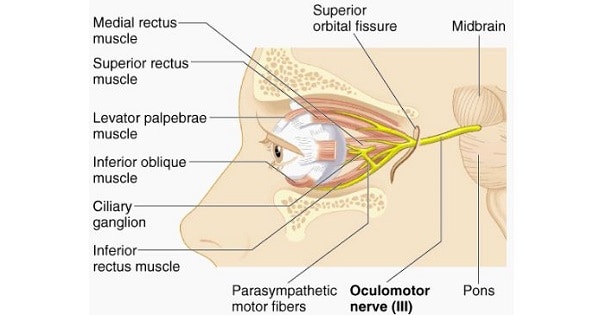
OCCULOMOTOR (III) NERVE
Nerve compressed by aneurysm of posterior communicating artery is
| A |
Occulomotor nerve |
|
| B |
Optic nerve |
|
| C |
Hypophysis cerebri |
|
| D | Trochlear nerve |
Nerve compressed by aneurysm of posterior communicating artery is
| A |
Occulomotor nerve |
|
| B |
Optic nerve |
|
| C |
Hypophysis cerebri |
|
| D | Trochlear nerve |
Occulomotor nerve [Ref: Harrison 17111/e p 1727; 16/c, p 2388; ivww.emedicine.com/med/topic3468.html]
- Most unruptured intracranial aneurysms are completely asymptomatic. Symptoms are usually due to rupture and resultant subarachnoid hemorrhage. Occasionally neurological symptoms may arise due to mass effect of the aneurysm.
- Progressively enlarging unruptured aneurysm most commonly involves the occulomotor nerve. This usually occurs .from an expanding aneurysm at junction of post communicating artery and internal carotid artery.
- Other neuropathies due to intracranial aneurysms are
- Cavernous sinus aneurysm can produce sixth nerve palsy.
- Supraclinoid carotid or anterior cerebral artery aneurysm can produce visual field defects.
- Posterior inferior cerebellar artery or anterior inferior cerebellar artery aneurysm may present as occipital & posterior cervical pain.
- An expanding middle cerebral artery aneurysm can produce pain in or behind the eye & in the low temple.
- Ophthalmic artery aneurysm can cause visual loss by compressing optic
nerve.
Which of the following extraocular muscle is not supplied by occulomotor nerve?
| A |
Inferior oblique |
|
| B |
Inferior rectus |
|
| C |
Medial rectus |
|
| D |
Lateral rectus |
Which of the following extraocular muscle is not supplied by occulomotor nerve?
| A |
Inferior oblique |
|
| B |
Inferior rectus |
|
| C |
Medial rectus |
|
| D |
Lateral rectus |
Lateral rectus muscle is supplied by abducens nerve. Extraocular muscles supplied by occulomotor nerve are superior, medial and inferior rectus and inferior oblique muscles. Trochlear nerve supplies superior oblique muscle.
- Medial rectus: Adduction
- Lateral rectus: Abduction
- Superior rectus: Elevation, intorsion, adduction
- Inferior rectus: Depression, extorsion, adduction
- Superior oblique: Intorsion, depression, abduction
- Inferior oblique: Extorsion, elevation, abduction
All the following are characteristics of occulomotor nerve except:
| A |
Carries parasympathetic nerve fibres |
|
| B |
Supplies inferior oblique muscle |
|
| C |
Enters orbit through the inferior orbital fissure |
|
| D |
Causes constriction of pupil |
All the following are characteristics of occulomotor nerve except:
| A |
Carries parasympathetic nerve fibres |
|
| B |
Supplies inferior oblique muscle |
|
| C |
Enters orbit through the inferior orbital fissure |
|
| D |
Causes constriction of pupil |
C i.e. Enters orbit through the inferior orbital fissure
Which is not a feature of occulomotor nerve palsy‑
| A |
Miosis |
|
| B |
Difficulty in accommodation |
|
| C |
Superior gaze palsy |
|
| D |
Diplopia |
Which is not a feature of occulomotor nerve palsy‑
| A |
Miosis |
|
| B |
Difficulty in accommodation |
|
| C |
Superior gaze palsy |
|
| D |
Diplopia |
A i.e., Miosis

Which action of extra-ocular muscle is spared in involvement of Occulomotor nerve :
| A |
Abduction |
|
| B |
Depression |
|
| C |
Elevation |
|
| D |
Adduction |
Which action of extra-ocular muscle is spared in involvement of Occulomotor nerve :
| A |
Abduction |
|
| B |
Depression |
|
| C |
Elevation |
|
| D |
Adduction |
A i.e. Abduction
Cross section of midbrain at the level of superior colliculus shows :
| A |
Red nucleus and trochlear nerve nucleus |
|
| B |
Rednucleus and abducent nerve nucleus |
|
| C |
Red nucleus and optic nerve nucleus |
|
| D |
Red nucleus and occulomotor nerve nucleus |
Cross section of midbrain at the level of superior colliculus shows :
| A |
Red nucleus and trochlear nerve nucleus |
|
| B |
Rednucleus and abducent nerve nucleus |
|
| C |
Red nucleus and optic nerve nucleus |
|
| D |
Red nucleus and occulomotor nerve nucleus |
- The midbrain is the narrow part of the brain that passes through the tentorial notch and connects the forebrain to the hindbrain. The midbrain comprises two lateral halves called the cerebral peduncles; each of these is divided into an anterior part, the crus cerebri, and a posterior part, the tegmentum, by a pigmented band of gray matter, the substantia nigra.
Cross section of midbrain at the level of superior colliculus:
Grey matter
- Central grey matter contains nucleus of oculomotor nerve and the mesencephalic nucleus of the trigeminal nerve
- Pretectal nucleus
- Red nucleus
- Substantia nigra
- Superior colliculus
Nucleus of trochlear nerve is present in the midbrain at the level of inferior colliculus
Which of the following is not a feature of occulomotor nerve palsy:
September 2010
| A |
Mydriasis |
|
| B |
Absent papillary reflex |
|
| C |
Proptosis |
|
| D |
Ptosis |
Which of the following is not a feature of occulomotor nerve palsy:
September 2010
| A |
Mydriasis |
|
| B |
Absent papillary reflex |
|
| C |
Proptosis |
|
| D |
Ptosis |
Ans. C : Proptosis
Features of 3rd cranial nerve palsy:
- Downward and outward deviated eye
- Ptosis
- Dilated pupils
- Loss of pupillary/ light and accommodation reflexes.
- Absent medial and upward gaze.
Occulomotor nerve supplies all extraocular muscles except ‑
| A |
Superior rectus |
|
| B |
Inferior rectus |
|
| C |
Lateral rectus |
|
| D |
Medial rectus |
Occulomotor nerve supplies all extraocular muscles except ‑
| A |
Superior rectus |
|
| B |
Inferior rectus |
|
| C |
Lateral rectus |
|
| D |
Medial rectus |
Ans. is ‘c’ i.e., Lateral rectus
Lateral rectus is supplied of by sixth nerve (abducent) nerve and superior oblique is supplied by fourth (trochlear) nerve. All other extraocular muscles are supplied by occulmotor nerve.

