
ORDER OF KINETICS
Zero order kinetics is independent of:
| A | Plasma concentration | |
| B |
Clearance |
|
| C | Volume of distribution | |
| D |
Half life |
Zero order kinetics is independent of:
| A | Plasma concentration | |
| B |
Clearance |
|
| C | Volume of distribution | |
| D |
Half life |
Plasma concentration REF: Katzung’s pharmacology 10th edition page 38 See APPENDIX-33 for ‘Chemical kinetics of drugs”
Drugs may follow zero order, first order or second order kinetics. It depends on following formula:
Rate of elimination a [plasma concentration]°r`l”
Thus for zero order kinetics, rate of elimination is independent of plasma concentration.
| A | Phenytoin and Ethanol | |
| B | Digoxin and Propranolol | |
| C | Amiloride and Probenecid | |
| D | Lithium and Theophyline |
| A | Phenytoin and Ethanol | |
| B | Digoxin and Propranolol | |
| C | Amiloride and Probenecid | |
| D | Lithium and Theophyline |
Phenytoin and Ethanol
Which of the following statement regarding first order kinetics is true?
| A |
It is independent of plasma concentration |
|
| B |
Tl/2 of the drug increases with dose |
|
| C |
Clearance of the drug decreases with dose |
|
| D |
A constant proportion of plasma concentration is eliminated |
Which of the following statement regarding first order kinetics is true?
| A |
It is independent of plasma concentration |
|
| B |
Tl/2 of the drug increases with dose |
|
| C |
Clearance of the drug decreases with dose |
|
| D |
A constant proportion of plasma concentration is eliminated |
According to first order kinetics of elimination the rate of elimination of a drug is directly propotional to the drug concentration.
Clearence of the drug remains constant and a constant fraction of drug is eliminated in unit time.
Which statement about first order kinetics is TRUE?
| A |
Constant amount of drug is eliminated |
|
| B |
Rate of elimination remains constant |
|
| C |
Rate of elimination is directly proportional to drug concentration |
|
| D |
Free drug concentration increases after successive doses |
Which statement about first order kinetics is TRUE?
| A |
Constant amount of drug is eliminated |
|
| B |
Rate of elimination remains constant |
|
| C |
Rate of elimination is directly proportional to drug concentration |
|
| D |
Free drug concentration increases after successive doses |
In first order/exponential kinetics:
- Rate of elimination is proportional to the plasma drug concentration
- Clearence and tl/2 remains constant
- Constant fraction of the drug is eliminated in unit time
- Most of the drugs follow first order kinetics
- Rate of elimination remains constant irrespective of the plasma drug concentration.
- CL decreases with increase in plasma drug concentration
- Constant amount of the drug is eliminated in unit time
Zero order kinetics is otherwise known as saturation kinetics. It is independent of:
| A |
Plasma concentration |
|
| B |
Clearance |
|
| C |
Volume of distribution |
|
| D |
Half life |
Zero order kinetics is otherwise known as saturation kinetics. It is independent of:
| A |
Plasma concentration |
|
| B |
Clearance |
|
| C |
Volume of distribution |
|
| D |
Half life |
In zero-order kinetics or saturation kinetics, elimination mechanisms become saturated and unable to process more drug when drug concentrations rise.
Consequently, for drugs that are eliminated by zero-order kinetics, a constant amount of drug is eliminated per unit time regardless of drug plasma concentration.
Zero order kinetics occur in which of the following drug with high doses?
| A |
Phenytoin and Propranolol |
|
| B |
Digoxin and Propranolol |
|
| C |
Amiloride and Probenecid |
|
| D |
Lithium and Theophylline |
Zero order kinetics occur in which of the following drug with high doses?
| A |
Phenytoin and Propranolol |
|
| B |
Digoxin and Propranolol |
|
| C |
Amiloride and Probenecid |
|
| D |
Lithium and Theophylline |
True statement regarding first order kinetics is ‑
| A |
Independent of plasma concentration |
|
| B |
A constant proportion of plasma concentration is eliminated |
|
| C |
T 1/2 increases with dose |
|
| D |
Clearance decreases with dose |
True statement regarding first order kinetics is ‑
| A |
Independent of plasma concentration |
|
| B |
A constant proportion of plasma concentration is eliminated |
|
| C |
T 1/2 increases with dose |
|
| D |
Clearance decreases with dose |
Ans. is ‘b’ i.e., A constant proportion of plasma concentration is eleminated
|
First Order Kinetics
|
Zero Order Kinetics (Non linear Kinetics)
concentrations
|
True about first order kinetics is –
| A |
Dose dependent elimination occurs |
|
| B |
Rate of elimination decrease with increase plasma concentration |
|
| C |
Rate of elimination does not depend on plasma concentration of drug |
|
| D |
Clearance is constant |
True about first order kinetics is –
| A |
Dose dependent elimination occurs |
|
| B |
Rate of elimination decrease with increase plasma concentration |
|
| C |
Rate of elimination does not depend on plasma concentration of drug |
|
| D |
Clearance is constant |
Ans. is ‘d’ i.e., Clearance is constant
Clearance is constant in first order kinetics
On higher doses zero order kinetics is seen ‑
| A |
Phenytoin |
|
| B |
Propranolal |
|
| C |
Lithium |
|
| D |
a and b |
On higher doses zero order kinetics is seen ‑
| A |
Phenytoin |
|
| B |
Propranolal |
|
| C |
Lithium |
|
| D |
a and b |
Ans. is `a>b’ i.e., Phenytoin>Propranolal
o The drugs whose kinetics changes from first order to zero order at therapeutic concentration are said to follow pseudo – zero order kinetics or mixed order kinetics or saturation kinetics.
o Drugs showing zero/pseudo-zero order kinetics :
|
Phenytoin |
Theophylline Alcohol |
Tolbutamide Warfarin Salicylates (Aspirin)
Propanolol (ref- Pharmocolgy recap)
About option b
o Some textbooks have mentioned that propranolol also shows zero order kinetics:
“Examples of drugs used in critically ill patients that have saturable elimination includes phenytoin. warfarin and propranolol’——————————- ‘Critical care medicine
“Some drugs where mechanics of elimination get saturated and elimination kinetics changes from .first order to zero order at higher doses are phenytoin, theophylline, salicylates, propranolol and tolbutamide’——————– Essentials pharmacology
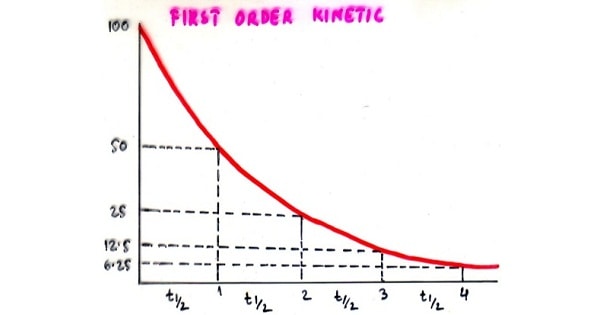
Elimination after 4 half lives in first order Kinetics is –
| A |
84% |
|
| B |
93% |
|
| C |
80.5% |
|
| D |
4.75% |
Elimination after 4 half lives in first order Kinetics is –
| A |
84% |
|
| B |
93% |
|
| C |
80.5% |
|
| D |
4.75% |
Ans. is ‘b’ i.e., 93%
|
Half life |
Elimination |
|
I t1/2 |
50% |
|
2 0/2 |
75% |
|
3 t1/2 |
87.5% |
|
41% |
93.75% |
|
5 t1/2 |
96.875 |
Elimination after 3 half lives in first order kinetics is –
| A |
12.5% | |
| B |
75% |
|
| C |
87.5% |
|
| D |
94% |
Elimination after 3 half lives in first order kinetics is –
| A |
12.5% | |
| B |
75% |
|
| C |
87.5% |
|
| D |
94% |
Ans. is ‘c’ i.e., 87.5%
For drugs with first order kinetics the time required to achieve steady state levels can be predicted from
| A |
Volume of distribution |
|
| B |
Half life |
|
| C |
Clearance |
|
| D |
Loading dose |
For drugs with first order kinetics the time required to achieve steady state levels can be predicted from
| A |
Volume of distribution |
|
| B |
Half life |
|
| C |
Clearance |
|
| D |
Loading dose |
Ans. is ‘b’ i.e., Half-life
Steady stateplasma concentration
After 5 t1/2, nearly complete drug is eliminated from the body
o If a constant dose of drug is repeated before 5 V/2, the concentration in blood will be higher, because some remnant of the previous dose will be present in the body.
o So, when a drug is infused at a constant rate the plasma concentration rises until a state is reached at which the rate of administration of drug to the body is exactly equal to the rate of elimination.
o This is called the steady state —> when it is attained the amount of drug in the body remains constant i.e. the plasma concentration is on a plateau —> plateau principal of drug accumulation.
o If a drug is administered by a constant rate the time to reach steady state depends only on the t1/2.
o With passage of each V/2 period of time, the plasma concentration rises by half the difference between the current concentration and the ultimate steady state (100%) concentration.
o For all practical purposes, after 5 t1/2 the amount of drug in the body will be constant and the plasma concentration will be at a plateau.
o For example, if a drug with t1/2 4 hours and plasma concentration 100 mg/ml is given at a constant rate ie every 4 hrs.
1st dose —> at 0 hrs
2nd dose —> at 4 hrs
3rd dose at 8 hrs
4th dose —> at 12 hrs——————– so on.
o After 4 hrs (1 t1/2) the drug concentration —> 50 mg/ml.
o After 8 hrs (2 t1/2) 75 mg/ml (50 of 1 st dose + 25 of 2″ dose)
o After 12 hrs (3 t’/2) —> 87.5 mg/ml (50 of 3″ dose + 25 of 2″ dose + 12.5 of 1′ dose)
o After 16 hrs (4 t1/2) —> 93.75 (50 of 4th dose + 25 of 3rd dose + 12.5 of 2′ dose + 6.25 of 1″ dose)
o After 20 hrs (5 t1/2) —> 96.875 (50 of 5th dose + 25 of 4th dose + 12.5 of 3rd dose + 6.25 of 2′ dose + 3.125 of V dose) o After 24 hrs (6 t1/2) –> 96.875 (50 of 6th dose + 25 of 5th dose + 12.5 of 4th dose + 6.25 fo 3rd dose + 3.125 of 2′ dose
+ nil from 1st dose, after 5 t1/2 nearly complete drug elimination occurs & first dose is eliminated after 5 VA).
o So, after 5 t1/2 plasma concentration will be constant.
First order kinetics is:
September 2005
| A |
Absorption of the drug is independent of the serum concentration |
|
| B |
Elimination of the drug is independent of the serum concentration. |
|
| C |
Elimination of the drug is proportional to the serum concentration |
|
| D |
Absorption of the drug is proportional to the serum concentration |
First order kinetics is:
September 2005
| A |
Absorption of the drug is independent of the serum concentration |
|
| B |
Elimination of the drug is independent of the serum concentration. |
|
| C |
Elimination of the drug is proportional to the serum concentration |
|
| D |
Absorption of the drug is proportional to the serum concentration |
Ans. C: Elimination of the drug is proportional to the serum concentration.
A 0-order kinetics has a rate which is independent of the concentration of the reactant(s). Increasing the concentration of the reacting species will not speed up the rate of the reaction. Zero-order reactions are typically found when a material that is required for the reaction to proceed, such as a surface or a catalyst, is saturated by the reactants.
With first-order elimination, the rate of elimination is directly proportional to the serum drug concentration (SDC). There is a linear relationship between rate of elimination and SDC. Although the amount of drug eliminated in a first-order process changes with concentration, the fraction of a drug eliminated remains constant.
The elimination rate constant (Kel) represents the fraction of drug eliminated per unit of time.
Following drugs show zero order kinetics except‑
| A |
Phenytoin |
|
| B |
Tolbutamide |
|
| C |
Alcohol |
|
| D |
Fomipizole |
Following drugs show zero order kinetics except‑
| A |
Phenytoin |
|
| B |
Tolbutamide |
|
| C |
Alcohol |
|
| D |
Fomipizole |
Ans. is `d’ i.e., Fomipizole
- The drugs whose kinetics changes from first order to zero order at therapeutic concentration are said to follow pseudo – zero order kinetics or mixed order kinetics or saturation kinetics.
Drugs showing zero/pseudo-zero order kinetics :
- Phenytoin
- Theophylline
- Alcohol
- Tolbutamide
- Warfarin
- Salicylates (Aspirin)
- Propanolol (ref- Pharmocolgy recap)
Elimination after 4 half lives in first order Kinetics is
| A |
84% |
|
| B |
93% |
|
| C |
80.5% |
|
| D |
4.75% |
Elimination after 4 half lives in first order Kinetics is
| A |
84% |
|
| B |
93% |
|
| C |
80.5% |
|
| D |
4.75% |
Ans. is ‘b’ i.e., 93%
| Half life |
Elimination |
| 1t%2 | 50% |
| 2t’/2 |
75% |
| 3 0/2 |
87.5% |
| 41 | 93.75% |
| 5 t’/ | 96.875 |

