


Pedestrian Injury
Most common site of primary impact injury topedestrians in a motor vehicle accident is…
| A |
Abdoemn |
|
| B |
Legs |
|
| C |
Head |
|
| D |
Chest |
Most common site of primary impact injury topedestrians in a motor vehicle accident is…
| A |
Abdoemn |
|
| B |
Legs |
|
| C |
Head |
|
| D |
Chest |
legs [Ref: Reddy 25/e, p 240; Parikh 6/e, p 4.130]
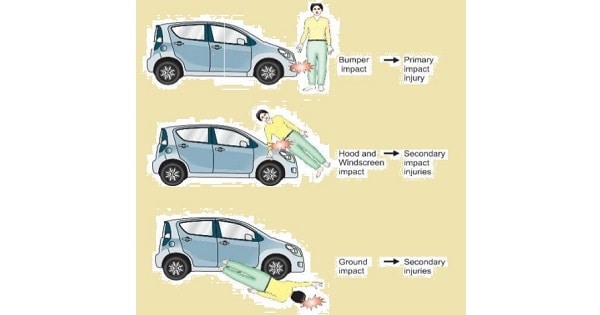
Three types of injuries are seen in pedestrians in a motor vehicles injury.
1. Primary impact injuries (the first part struck)
– These injuries are caused by the first impact between the vehicle and the pedestrian.
2. Secondary impact injuries (further injuries by the same vehicle)
– These injuries are d/t subsequent impact with the same vehicle, for eg. the pedestrian may be lifted on to the vehicle after the initial impact.
3. Secondary injuries (sometimes also called tertiary injuries)
– These are the injuries caused d/t the victim falling on the ground or other stationary object.
- In primary impact injuries, the site and nature of injuries depend on the height of the pedestrian and upon the position of the person in relation to the vehicle when struck, i.e. whether crossing the road from one side to the
other walking with or against the traffic. The injuries also depend upon the relative heights of various parts of the
vehicle, i.e. bumper, radiator, fenders.
- In a typical case, the victim is struck by the front of the vehicle. An adult usually sustains injuries on the legs and a child on the head.
- Fracture of the tibia and, fibula of one or both legs is k/a bumper fracture.
– The fracture is usually spiral or wedge shaped. The base of the triangular fragment of bone indicates the site of the impact and the apex points in the direction in which the vehicle was travelling.
– In a bumber fracture, the distance from the heel to the ,fracture sire gives information regarding height of the bumper and whether brakes were applied or not. When brakes are applied before the accident, the legs are injured at a lower level. (The .front bumber tends to rise during acceleration and dip under braking.
- If the pedestrian is hit from the side, there may be unilateral fracture of the nearest leg.
- If the pedestrian is facing the vehicle. he may sustain intra-abdominal injuries and/or injuries to the chest wall and thoracic contents. Sometimes the pelvis is fractured.
Which of the following represents Bumper’s fracture?
| A |
Comminuted fracture of vertebral body |
|
| B |
Comminuted intra articular fracture of distal tibial end |
|
| C |
Comminuted, depressed fracture of the lateral tibial condyle |
|
| D |
Avulsion fracture of the base of 5th metatarsa |
Which of the following represents Bumper’s fracture?
| A |
Comminuted fracture of vertebral body |
|
| B |
Comminuted intra articular fracture of distal tibial end |
|
| C |
Comminuted, depressed fracture of the lateral tibial condyle |
|
| D |
Avulsion fracture of the base of 5th metatarsa |
Bumper’s fracture is the comminuted, depressed fracture of the lateral tibial condyle.
- Comminuted fracture of vertebral body is called Burst fracture
- Comminuted intra articular fracture of distal tibial end is called Pilon’s fracture
- Avulsion fracture of the base of 5th metatarsal is called Jones’s fracture
Ref: Maheshwari 3/e, Page 2-3.
Extensive abrasions are found all over the body of a pedestrian lying by the road side. What is the likely cause?
| A |
Primary Impact Injury |
|
| B |
Secondary Impact Injury |
|
| C |
Secondary Injury |
|
| D |
Postmortem artifact |
Extensive abrasions are found all over the body of a pedestrian lying by the road side. What is the likely cause?
| A |
Primary Impact Injury |
|
| B |
Secondary Impact Injury |
|
| C |
Secondary Injury |
|
| D |
Postmortem artifact |
B i.e. Secondary Impact Injury


Degloving injury is:
March 2013 (h)
| A |
Surgeon made wound |
|
| B |
Lacerated wound |
|
| C |
Blunt injury |
|
| D |
Avulsion injury |
Degloving injury is:
March 2013 (h)
| A |
Surgeon made wound |
|
| B |
Lacerated wound |
|
| C |
Blunt injury |
|
| D |
Avulsion injury |
Ans. D i.e. Avulsion injury
Degloving injury
- It is a type of avulsion in which an extensive section of skin is completely torn off the underlying tissue, severing its blood supply.
- It is named by analogy to the process of removing a glove.
- Typically, degloving injuries affect the extremities and limbs.
Bumper fracture is:
Rohtak 06
| A |
Primary impact injury |
|
| B |
Secondary impact injury |
|
| C |
Tertiary impact injury |
|
| D |
Secondary injury |
Bumper fracture is:
Rohtak 06
| A |
Primary impact injury |
|
| B |
Secondary impact injury |
|
| C |
Tertiary impact injury |
|
| D |
Secondary injury |
Ans. Primary impact injury
Extensive abrasions are found on the body of a pedestrian. The cause is:
AI 09
| A |
Primary impact injury |
|
| B |
Secondary impact injury |
|
| C |
Secondary injury |
|
| D |
Postmortem artifact |
Extensive abrasions are found on the body of a pedestrian. The cause is:
AI 09
| A |
Primary impact injury |
|
| B |
Secondary impact injury |
|
| C |
Secondary injury |
|
| D |
Postmortem artifact |
Ans. Secondary injury
Which a vehicular injury is not caused by direct contact of vehicle ‑
| A |
Primary impact |
|
| B |
Secondary impact |
|
| C |
Secondary injury |
|
| D |
Rolling over |
Which a vehicular injury is not caused by direct contact of vehicle ‑
| A |
Primary impact |
|
| B |
Secondary impact |
|
| C |
Secondary injury |
|
| D |
Rolling over |
Ans. is ‘c’ i.e., Secondary injury
Pedestrian injuries
Following patterns of injuries are seen :‑
1) Primary impact injuries : It is caused due to initial impact between vehicle and pedestrian. The height of the pedestrian often determines the site of impact and injuries, for example, they are usually found on head in children and on the trunk and legs in adults. Overall, the most common site is leg (85%), followed by head (50-80%) > arms > pelvis > chest or abdomen > neck and spine.
2) Secondary impact injuries : These are due to subsequent impact with the same vehicle, as may result from being lifted on to the vehicle after the initial impact:-
- Secondary impact injuries are also usually seen on the same side as the primary impact injuries (side facing the vehicle) when the body is thrown on the vehicle although they may be seen on other surfaces such as during ran over injuries.
- If the initial impact was below the centre of gravity (as occurs in adult and older child), it tends to lift the victim up onto bonnet/hood of vehicle (scooping up) or even on road behind the vehicle and cause severe head injuries, laceration (due to secondary impact or contact with windshield) and run over by passing vehicle.
- If the initial point of impact was at or above the centre of gravity (as occurs in children), he is directly thrown to ground (due to primary impact) and is run over by same car with consequent secondary impact under carriage injuries which may include burns from hot exhaust pipe and stains from grease oil etc.
3) Secondary injuries : These are caused by person violently falling on ground or on stationary object. These are found on parts opposite to primary impact or on head. Injuries due to contact with ground include abrasion and bruises over the face, hand, hips and legs, and laceration over the bony prominences.
4) Rolling/Runover (degloving injuries) : Caused by wheel of vehicle or rolling over the victim. Children are oftenly involved.
A moving vehicle hits a pedestrian on his lateral aspect of the knee and causes a fracture. The fracture line is passing through the intercondylar eminence. Which of the following structures will most likely be injured
| A |
Medial collateral ligament |
|
| B |
Lateral collateral ligament |
|
| C |
Anterior cruciate ligament |
|
| D |
Medial meniscus |
Ans. c. Anterior cruciate ligament

