
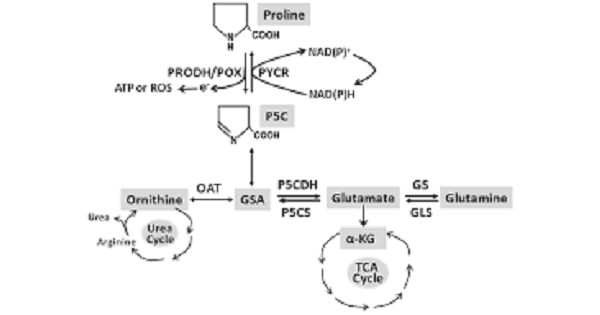
Proline
Metabolism of proline takes place in:
| A |
Mitochondria |
|
| B |
Cell membrane |
|
| C |
Ribosome |
|
| D |
All of the above |
Metabolism of proline takes place in:
| A |
Mitochondria |
|
| B |
Cell membrane |
|
| C |
Ribosome |
|
| D |
All of the above |
The catabolism of proline takes place in mitochodria.
Since proline does not participate in transamination, the nitrogen of this imino acid is retained throughout its oxidation to 1-pyrolline-5-carboxylate, ring opening to glutamate–semialdehyde, and oxidation to glutamate, and is only removed during transamination of glutamate to α-ketoglutarate
Ref: Harper 28th edition, chapter 29.
The amino acid residue having an iminoside chain is:
| A |
Lysine |
|
| B |
Histidine |
|
| C |
Tyrosine |
|
| D |
Proline |
The amino acid residue having an iminoside chain is:
| A |
Lysine |
|
| B |
Histidine |
|
| C |
Tyrosine |
|
| D |
Proline |
Proline does not contain the amino acid group; but only imino group(=NH).
Ref: Textbook of Biochemistry By Vasudevan, 5th Edition
A mutation is MOST likely to alter the three-dimensional conformation of a protein if:
| A |
There is a substitution of a hydrophobic amino acid for a hydrophilic amino acid |
|
| B |
Valine is substituted for leucine |
|
| C |
It changes the amino acid at the amino-terminus |
|
| D |
It places proline in the middle of a α-helix |
The geometry of proline is incompatible with the α-helix. The substitution of a hydrophobic for a hydrophilic amino acid may or may not produce a change in the structure of a protein molecule. Substitution of the hydrophobic valine for another hydrophobic residue, leucine, would be predicted to have little effect on the structure of the protein. Substitution at the amino or carboxyl end of the molecule may or may not produce a change in the protein structure.
The amino acid residue having iminoside chain is?
| A |
Lysine |
|
| B |
Arginine |
|
| C |
Tyrosine |
|
| D |
Proline |
The amino acid residue having iminoside chain is?
| A |
Lysine |
|
| B |
Arginine |
|
| C |
Tyrosine |
|
| D |
Proline |
The side chain of proline makes pyrrolidine ring structure with imino group.
Amino acid, that destabilizes alpha-helix is:
| A |
Proline |
|
| B |
Alanine |
|
| C |
Glutamine |
|
| D |
Tryptophan |
Amino acid, that destabilizes alpha-helix is:
| A |
Proline |
|
| B |
Alanine |
|
| C |
Glutamine |
|
| D |
Tryptophan |
Proline lacks an amide proton, this precludes hydrogen bonding between it and hydrogen bond acceptors, and thus often restricts the residue to the first four positions of an α-helix.
Helices with proline after position four have a pronounced kink.
Which of the following elements is not required for hydroxylation of proline in collagen synthesis?
| A |
Vit C |
|
| B |
O2 |
|
| C |
Dioxygenases |
|
| D |
Pyridoxal phosphate |
Which of the following elements is not required for hydroxylation of proline in collagen synthesis?
| A |
Vit C |
|
| B |
O2 |
|
| C |
Dioxygenases |
|
| D |
Pyridoxal phosphate |
Fe2+ and α–ketoglutrate are also needed in hydroxylation of proline for collagen synthesis.
All of the following are required for hydroxylation of proline in collagen synthesis except :
| A |
02 |
|
| B |
Vitamin C |
|
| C |
Dioxygenases |
|
| D |
Pyridoxal phosphate |
All of the following are required for hydroxylation of proline in collagen synthesis except :
| A |
02 |
|
| B |
Vitamin C |
|
| C |
Dioxygenases |
|
| D |
Pyridoxal phosphate |
D i.e. Pyridoxal phosphate
Vitamin required for hydroxyproline to proline conversion:
| A |
Vitamin C |
|
| B |
Vitamin E |
|
| C |
Pvrodoxal PO4 |
|
| D |
Biotin |
Vitamin required for hydroxyproline to proline conversion:
| A |
Vitamin C |
|
| B |
Vitamin E |
|
| C |
Pvrodoxal PO4 |
|
| D |
Biotin |
A i.e. Vitamin C
An amino acid which does not participate by ahelix formation is:
| A |
Leucine |
|
| B |
Glycine |
|
| C |
Proline |
|
| D |
Lysine |
An amino acid which does not participate by ahelix formation is:
| A |
Leucine |
|
| B |
Glycine |
|
| C |
Proline |
|
| D |
Lysine |
C i.e. Proline
The amino acid residue having an iminoside chain is:
| A |
Lysine |
|
| B |
Histidine |
|
| C |
Tyrosine |
|
| D |
Proline |
The amino acid residue having an iminoside chain is:
| A |
Lysine |
|
| B |
Histidine |
|
| C |
Tyrosine |
|
| D |
Proline |
Ans:D.)Proline.
Proline has a secondary amino group, and hence it is an imino acid.
Glutamate is NOT a precursor of:
| A |
GABA |
|
| B |
Proline |
|
| C |
Glutathione |
|
| D |
Histidine |
Glutamate is NOT a precursor of:
| A |
GABA |
|
| B |
Proline |
|
| C |
Glutathione |
|
| D |
Histidine |
Glutamate
- It is one of the most metabolically active of all amino acids.
- It is a precursor to:
Glutamine,
Arginine,
Creatine phosphate, Proline,
Hydroxyproline, Polyamines,
Glutathione, and Gamma-aminobutyric acid (GABA).
- GABA, is a neurotransmitter, and is also involved in the synthesis of glutathione.
- In addition, glutamate itself is a neurotransmitter.
Succinyl CoA is formed by all except ‑
| A |
Proline |
|
| B |
Isoleucine |
|
| C |
Methionine |
|
| D |
Valine |
Succinyl CoA is formed by all except ‑
| A |
Proline |
|
| B |
Isoleucine |
|
| C |
Methionine |
|
| D |
Valine |
Purely glucogenic amino acid ‑
| A |
Isoleucine |
|
| B |
Tyrosine |
|
| C |
Lysine |
|
| D |
Proline |
Purely glucogenic amino acid ‑
| A |
Isoleucine |
|
| B |
Tyrosine |
|
| C |
Lysine |
|
| D |
Proline |
All of the following are the components of collagen except:
| A |
Glycine |
|
| B |
Lysine |
|
| C |
Proline |
|
| D |
Desmosine |
All of the following are the components of collagen except:
| A |
Glycine |
|
| B |
Lysine |
|
| C |
Proline |
|
| D |
Desmosine |
Ans. d. Desmosine

