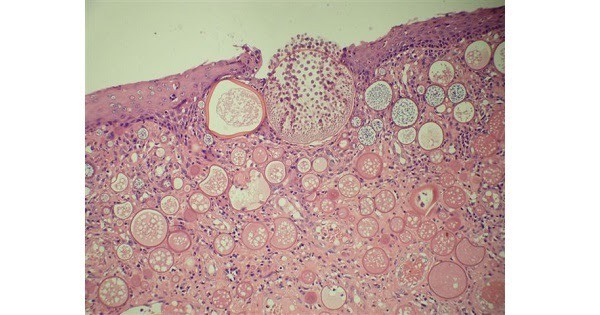
Rhinosleroma
Mikulicz cells and Russell bodies are seen in _________
| A |
Rhinoscleroma |
|
| B |
Rhinosporidiosis |
|
| C |
Scleroderma |
|
| D |
Lupus vulgaris |
Mikulicz cells and Russell bodies are seen in _________
| A |
Rhinoscleroma |
|
| B |
Rhinosporidiosis |
|
| C |
Scleroderma |
|
| D |
Lupus vulgaris |
A roomy nasal cavity with thick crust formation and woody hard external nose is seen in?
| A |
Rhinoscleroma |
|
| B |
Rhinosporidiosis |
|
| C |
Atrophic rhinitis |
|
| D |
Vasomotor rhinitis |
A roomy nasal cavity with thick crust formation and woody hard external nose is seen in?
| A |
Rhinoscleroma |
|
| B |
Rhinosporidiosis |
|
| C |
Atrophic rhinitis |
|
| D |
Vasomotor rhinitis |
Large nasal cavity with thick crust formation internally and ‘woody’ feel of external nose is TRUE about?
| A |
Rhinoscleroma |
|
| B |
Rhinosporidiosis |
|
| C |
Atrophic rhinitis |
|
| D |
Vasomotor rhinitis |
Large nasal cavity with thick crust formation internally and ‘woody’ feel of external nose is TRUE about?
| A |
Rhinoscleroma |
|
| B |
Rhinosporidiosis |
|
| C |
Atrophic rhinitis |
|
| D |
Vasomotor rhinitis |
- Rhinoscleroma is caused by the gram-negative coccobacillus K rhinoscleromatis.
The disease begins in areas of epithelial transition such as the vestibule of the nose, the subglottic area of the larynx. It resembles atrophic rhinitis in atrophic stage. Subdermal infiltration of lower part of external nose and upper lip gives a ‘woody’ feel.
- Atrophic rhinitis is characterised by progressive atrophy of the nasal mucosa along with the underlying bones of turbinates. There is also presence of foul smelling crusts. But woody external nose is not seen.
Histology of a specimen shows Mikulicz cells and Russell bodies. These are characteristic of:
| A |
Rhinoscleroma |
|
| B |
Rhinosporidiosis |
|
| C |
Scleroderma |
|
| D |
Lupus vulgaris |
Histology of a specimen shows Mikulicz cells and Russell bodies. These are characteristic of:
| A |
Rhinoscleroma |
|
| B |
Rhinosporidiosis |
|
| C |
Scleroderma |
|
| D |
Lupus vulgaris |
The classic biopsy findings compatible with rhinoscleroma include Mikulicz cells, macrophages containing large amounts of bacteria-filled vacuoles, and Russell bodies, spherical structures found in the cytoplasm of plasma cells.
Mikulicz cells are large mononuclear histiocytes with vacuolated cytoplasm containing causative bacilli and Russell bodies are homogenous eosinophilic inclusion bodies found in the plasma cells.
ENT examination of an old man shows roomy nasal cavities, crust formation and woody hard external nose; which are seen in:
| A |
Rhinoscleroma |
|
| B |
Rhinosporidiosis |
|
| C |
Atrophic rhinitis |
|
| D |
None of the above |
ENT examination of an old man shows roomy nasal cavities, crust formation and woody hard external nose; which are seen in:
| A |
Rhinoscleroma |
|
| B |
Rhinosporidiosis |
|
| C |
Atrophic rhinitis |
|
| D |
None of the above |
Rhinoscleroma:
It is a rare, chronic progressive granulomatous disease of the upper respiratory tract caused by Klebsiella rhinoscleromatis.
True about rhinoscleroma are all, EXCEPT:
| A |
Caused by Klebsiella pneumonia |
|
| B |
Slowly progressing granulomatous disease |
|
| C |
Most common in young adults 20–30 years old |
|
| D |
Poor nutrition contributes to its spread |
True about rhinoscleroma are all, EXCEPT:
| A |
Caused by Klebsiella pneumonia |
|
| B |
Slowly progressing granulomatous disease |
|
| C |
Most common in young adults 20–30 years old |
|
| D |
Poor nutrition contributes to its spread |
Drug of choice in rhinoscleromatosis is:
| A |
Tetracycline |
|
| B |
Fluoroquinolone |
|
| C |
Aminoglycosides |
|
| D |
None of the above |
Drug of choice in rhinoscleromatosis is:
| A |
Tetracycline |
|
| B |
Fluoroquinolone |
|
| C |
Aminoglycosides |
|
| D |
None of the above |
In rhinoscleromatosis, organism may be difficult to eradicate, despite aggressive therapy.
A combination of conservative surgical debridement and long-term antibiotic coverage is the mainstay of therapy for rhinoscleroma.
Tetracycline has been shown to be effective and inexpensive for patients unless contraindicated.
Fluoroquinolones may be used as an alternative, given their excellent gram-negative activity and convenient dosing regimen
Rhinoscleroma is caused by:
| A |
Klebsiella |
|
| B |
Autoimmune |
|
| C |
Spirochetes |
|
| D |
Rhinosporidium |
Rhinoscleroma is caused by:
| A |
Klebsiella |
|
| B |
Autoimmune |
|
| C |
Spirochetes |
|
| D |
Rhinosporidium |
Mikulicz cell and Russell bodies are characterisitic of:
| A |
Rhinoscleroma |
|
| B |
Rhinosporidiosis |
|
| C |
Plasma cell disorder |
|
| D |
Lethal midline granuloma |
Mikulicz cell and Russell bodies are characterisitic of:
| A |
Rhinoscleroma |
|
| B |
Rhinosporidiosis |
|
| C |
Plasma cell disorder |
|
| D |
Lethal midline granuloma |
Atrophic dry nasal mucosa, extensive encrustations with woody’ hard external nose is suggestive of
| A |
Rhinosporidiosis |
|
| B |
Rhinoscleroma |
|
| C |
Atrophic rhinitis |
|
| D |
Carcinoma of nose |
Atrophic dry nasal mucosa, extensive encrustations with woody’ hard external nose is suggestive of
| A |
Rhinosporidiosis |
|
| B |
Rhinoscleroma |
|
| C |
Atrophic rhinitis |
|
| D |
Carcinoma of nose |
Frish bacillus causes:
| A |
Rhinoscleroma |
|
| B |
Rhinosporidiosis |
|
| C |
Rhinophyma |
|
| D |
Lupus vulgaris |
Frish bacillus causes:
| A |
Rhinoscleroma |
|
| B |
Rhinosporidiosis |
|
| C |
Rhinophyma |
|
| D |
Lupus vulgaris |
Rhinoscleroma is a chronic granulomatous disease caused by Gram negative bacillus called Klebsiella rhinoscleromates or Frisch bacillus
Rhinoscleroma occurs due to ‑
| A |
Autoimmune cause |
|
| B |
Inflammatory cause |
|
| C |
Klebsiella rhinoscleromatis infection |
|
| D |
Mycotic infection |
Rhinoscleroma occurs due to ‑
| A |
Autoimmune cause |
|
| B |
Inflammatory cause |
|
| C |
Klebsiella rhinoscleromatis infection |
|
| D |
Mycotic infection |
Ans. is ‘c’ i.e., Klebsiellarhinoscleromatis infection
Rhinoscleroma
- The causative organism is Klebsiellarhinosclerontatisor Frisch bacillus, which can be cultured from the biopsy material.
- The disease is endemic in several parts of world.
- In India, it is seen more often in northern than in the southern parts.
- Biopsy shows infiltration of submucosa with plasma cells, lymphocytes, eosinophils, Mikulicz cells & Russell bodies.
- The latter two are diagnostic features of the disease.
- The disease starts in the nose & extends to nasopharynx, oropharynx, larynx, trachea & bronchi.
- Mode of infection is unknown.
- Both sexes of any age may be affected.