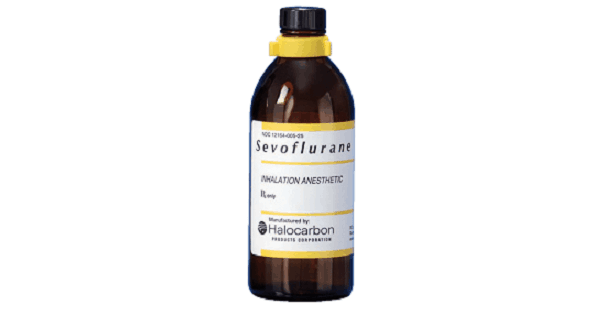
Sevoflurane
Anesthesia of choice for induction of anesthesia in children is?
| A | Desflurane | |
| B |
Halothane |
|
| C | Sevoflurane | |
| D | Isoflurane |
Anesthesia of choice for induction of anesthesia in children is?
| A | Desflurane | |
| B |
Halothane |
|
| C | Sevoflurane | |
| D | Isoflurane |
Sevoflurane REF: Morgan’s anesthesia 3″ ed p. 404, 570, 860, 884
“Sevoflurane is anesthetic of choice for induction in pediatrics because of rapid onset and non-pungency”
Induction in pediatrics patient
- Inhalation — Sevoflurane in N20
- Intravenous (preferred) – rapid acting barbiturate like thiopental or Propofol followed by non-depolarizing muscle relaxant.
- Intramuscular- Ketamine
- Muscle relaxant (MR)- Rocuronium
Which one of the following is the fastest acting inhalational agent:
| A |
Halothane |
|
| B | Isoflurane | |
| C | Ether | |
| D | Sevoflurane |
Which one of the following is the fastest acting inhalational agent:
| A |
Halothane |
|
| B | Isoflurane | |
| C | Ether | |
| D | Sevoflurane |
Sevoflurane
Anaesthetic without epileptogenic potential
| A |
Desflurane |
|
| B |
Sevoflurane |
|
| C |
Isoflurane |
|
| D |
Enflurane |
Anaesthetic without epileptogenic potential
| A |
Desflurane |
|
| B |
Sevoflurane |
|
| C |
Isoflurane |
|
| D |
Enflurane |
Ans:A.)Desflurane.
- Sevoflurane,Enflurane and Isoflurane have Epileptogenic potential.
Which one of the following anaesthetic agents causes a rise in the Intracranial pressure:
| A |
Sevoflurane |
|
| B |
Thiopentone sodium |
|
| C |
Lignocaine |
|
| D |
Propofol |
Which one of the following anaesthetic agents causes a rise in the Intracranial pressure:
| A |
Sevoflurane |
|
| B |
Thiopentone sodium |
|
| C |
Lignocaine |
|
| D |
Propofol |
Intracranial pressure is increased at high inspired concentration of sevoflurane but this effect is minimal over the 0.5-1MAC range.
Which of the following is an epileptogenic anesthetic agent?
| A |
Isoflurane |
|
| B |
Sevoflurane |
|
| C |
Methoxyflurane |
|
| D |
Halothane |
Which of the following is an epileptogenic anesthetic agent?
| A |
Isoflurane |
|
| B |
Sevoflurane |
|
| C |
Methoxyflurane |
|
| D |
Halothane |
Which of the following inhalational agents, is the induction agent of choice in children?
| A |
Isoflurane |
|
| B |
Desflurane |
|
| C |
Sevoflurane |
|
| D |
Methoxyflurane |
Which of the following inhalational agents, is the induction agent of choice in children?
| A |
Isoflurane |
|
| B |
Desflurane |
|
| C |
Sevoflurane |
|
| D |
Methoxyflurane |
Sevoflurane is considered to be the inhalational induction agent of choice in children,
since it has a pleasant, faster, and smooth induction with no significant systemic toxicity.
Anesthesia of choice for induction in children among the following is:
| A |
Desflurane |
|
| B |
Halothane |
|
| C |
Sevoflurane |
|
| D |
Isoflurane |
Anesthesia of choice for induction in children among the following is:
| A |
Desflurane |
|
| B |
Halothane |
|
| C |
Sevoflurane |
|
| D |
Isoflurane |
Sevoflurane is the induction agent of choice in pediatric anaesthesia.
It is associated with little mayocardial depression or dysrhythmias.
It has specific advantages over halothane when used in children with CHD,
particularly in children younger than 1 year of age and in cyanosed children.
It does not cause reduction in heart rate.
Inhalational Anaesthetics
Features of Liquid Inhalational Anaesthetic agents:
A 38-year old man presents for ventral hernia repair. He had a malignant hyperthermia crisis during prior surgery.
Assertion: Sevoflurane is contraindicated for induction of anaesthesia in this patient.
Reason: It is found to precipate malignant hyperthermia.
| A |
Both Assertion and Reason are true, and Reason is the correct explanation for Assertion |
|
| B |
Both Assertion and Reason are true, and Reason is not the correct explanation for Assertion |
|
| C |
Assertion is true, but Reason is false |
|
| D |
Assertion is false, but Reason is true |
A 38-year old man presents for ventral hernia repair. He had a malignant hyperthermia crisis during prior surgery.
Assertion: Sevoflurane is contraindicated for induction of anaesthesia in this patient.
Reason: It is found to precipate malignant hyperthermia.
| A |
Both Assertion and Reason are true, and Reason is the correct explanation for Assertion |
|
| B |
Both Assertion and Reason are true, and Reason is not the correct explanation for Assertion |
|
| C |
Assertion is true, but Reason is false |
|
| D |
Assertion is false, but Reason is true |
Since this patient gives a history of malignant hyperthermia during previous surgery,
sevoflurane is contraindicated in this patient.
Drugs known to precipitate malignant hyperthermia are succinylcholine, halothane, isoflurane, desflurane and sevoflurane.
Ref : Essentials of Medical Pharmacology By K D Tripathi 5th edn, page 340.
Inhalation agent of choice in children –
| A |
Methoxyflurane |
|
| B |
Sevoflurane |
|
| C |
Desflurane |
|
| D |
Isoflurane |
Inhalation agent of choice in children –
| A |
Methoxyflurane |
|
| B |
Sevoflurane |
|
| C |
Desflurane |
|
| D |
Isoflurane |
Ans. is ‘b’ i.e., Sevoflurane
“Unlike desflurane, sevoflurane poses no problem in induction, acceptability is good even by pediatric patients”.
Which one of the following is the fastest acting inhalational agent?
| A |
Halothane |
|
| B |
Isoflurane. |
|
| C |
Ether. |
|
| D |
Sevoflurane. |
Which one of the following is the fastest acting inhalational agent?
| A |
Halothane |
|
| B |
Isoflurane. |
|
| C |
Ether. |
|
| D |
Sevoflurane. |
D i.e. Sevoflurane
- The greater the uptake of anesthetic agent, the greater the difference between inspired and alveolar concentrations, and the slower the rate of induction.
- Three factors affects anesthetic uptake: Solubility in the blood, alveolar blood flow and difference in partial pressure between alveolar gas and venous blood.
- Many of the factors that speed induction also speed recovery: elimination .of rebreathing, high fresh gas flows, low anesthetic circuit volume, low absorption by the anesthetic circuit, decreased solubility, high cerebral flow, and increased ventilation.
- Because the concentration of a gas is directly proportional to its partial pressure, the alveolar partial pressure will also be slow to rise. The alveolar partial pressure is important because it determines the partial pressure of anesthetic in blood and, ultimately, in the brain. Similarly the partial pressure of anesthetic in brain is directly proportional to its brain tissue concentration, which determines clinical effect.
- v. Blood gas partition coefficient (B/G Coff.) is most important factor in determining the uptake of agent and so the speed of induction and recovery. The higher the B/G coefficient of an anesthetic, the greater its solubility in blood and its uptake in pulmonary circulation. As a result of this alveolar partial pressure rises much slowly & induction is prolonged. Agents with low blood gas partition coefficient will have high alveolar concentration. So the induction & recovery will be fast with agent with less B/G Coff.; and induction and recovery will be slower with agents with high, B/G partition coefficients. Q
- Agents in increasing order of B/G coefficients (or decreasing order of induction & recovery)
I Xe (0.14) Desflurane (0.42) > Cyclopropane (0.44) > N20 (0.47) > Sevoflurane (0.69) > Isoflurane (1.38) > Enflurane (1.8) > Halothane (2.4) > Chloroform (8) > Trielene (9) > Ether (12) > Methoxyflurane (15)
Which of the following is an epileptogenic anesthetic agent
| A |
Isoflurane |
|
| B |
Sevoflurane |
|
| C |
Methoxyflurane |
|
| D |
Halothane |
Which of the following is an epileptogenic anesthetic agent
| A |
Isoflurane |
|
| B |
Sevoflurane |
|
| C |
Methoxyflurane |
|
| D |
Halothane |
B i.e. Sevoflurane
A six year old child is posted for elective urology surgery under general anesthesia. He refuses to allow the anaesthesiologist an I.V. access. The best inhalational agent of choice for induction of anesthesia is:
| A |
Sevoflurane |
|
| B |
Methoxyflurane |
|
| C |
Desflurane |
|
| D |
Isoflurane |
A six year old child is posted for elective urology surgery under general anesthesia. He refuses to allow the anaesthesiologist an I.V. access. The best inhalational agent of choice for induction of anesthesia is:
| A |
Sevoflurane |
|
| B |
Methoxyflurane |
|
| C |
Desflurane |
|
| D |
Isoflurane |
A i.e. Sevoflurane
True about Sevoflurane-
| A |
Isopropyl ether |
|
| B |
MAC is 2% |
|
| C |
Good to use in old age |
|
| D |
All |
True about Sevoflurane-
| A |
Isopropyl ether |
|
| B |
MAC is 2% |
|
| C |
Good to use in old age |
|
| D |
All |
D. i.e. All of the above
NOT TRUE regarding sevoflurane
| A |
MAC is higher than isoflurane |
|
| B |
Blood gas coefficient is higher than desflurane |
|
| C |
Potency more than cardio depressant than isoflurane |
|
| D |
Sevoflurane is less cardio depressant than isoflurane |
NOT TRUE regarding sevoflurane
| A |
MAC is higher than isoflurane |
|
| B |
Blood gas coefficient is higher than desflurane |
|
| C |
Potency more than cardio depressant than isoflurane |
|
| D |
Sevoflurane is less cardio depressant than isoflurane |
D i.e., Sevoflurane is less cardiodepressant than isoflurane
Sevoflurane is inhalational agent of choice for inductioin of anesthesia in pediatric patients and adults, because of rapid onset of action & nonpengency Q
Desflurane & isoflurane are more pungent and are associated with more coughing breath holding & laryngeal spasm during inhalational inudction, so not used as first choiceQ.
Methoryflurane is highly nephrotoxic, so not preferred.
Sevoflurane is not recommended in closed circuit because there is chance of production of a toxic metabolic product compound A, Q (an olefin) in closed circuit.
– Unlike isoflurane & desflurane, both of which lead to tachycaridia, sevoflurane has minimal effect on heart rate.
Sevoflurane can cause direct myocardial depression (via calcium channels) and produce dose dependent depression of cardiac output, & reduction in systemic vascular resistance similar to that seen in isoflurane
Inhalational agent of choice in children:
| A |
Sevoflurane |
|
| B |
Isofurane |
|
| C |
Desflurane |
|
| D |
Halothane |
Inhalational agent of choice in children:
| A |
Sevoflurane |
|
| B |
Isofurane |
|
| C |
Desflurane |
|
| D |
Halothane |
A. i.e. Sevoflurane
In a child with intestinal obstruction with deranged liver function test, the anesthetic of choice is :
| A |
Enflurane |
|
| B |
Isoflurane |
|
| C |
Halothane |
|
| D |
Sevoflurane |
In a child with intestinal obstruction with deranged liver function test, the anesthetic of choice is :
| A |
Enflurane |
|
| B |
Isoflurane |
|
| C |
Halothane |
|
| D |
Sevoflurane |
D i.e. Sevoflurance
A 6 month old child is suffering from patent ductus arteriosus (PDA) with congestive cardiac failure. Ligation of ductus arteriosus was decided for surgical management. The most appropriate inhalational anaesthetic agent of choice with minimal haemodynamic alteration for induction of anaesthesia is:
| A |
Sevoflurane |
|
| B |
Isoflurane |
|
| C |
Enflurane |
|
| D |
Halothane |
A 6 month old child is suffering from patent ductus arteriosus (PDA) with congestive cardiac failure. Ligation of ductus arteriosus was decided for surgical management. The most appropriate inhalational anaesthetic agent of choice with minimal haemodynamic alteration for induction of anaesthesia is:
| A |
Sevoflurane |
|
| B |
Isoflurane |
|
| C |
Enflurane |
|
| D |
Halothane |
A i.e. Sevoflurane
Sevoflurane is the agent of choice for inhalational induction in pediatric patientQ. Desflurane isoflurane are not used for induction because theyr are more pungent & are associated with more coughing, breath holding & laryngospasm during an inhalational induction.
Which of the following anaesthetic agents causes a rise in the Intracranial pressure:
| A |
Sevoflurane. |
|
| B |
Thiopentone sodium. |
|
| C |
Lignocaine. |
|
| D |
Propofol. |
Which of the following anaesthetic agents causes a rise in the Intracranial pressure:
| A |
Sevoflurane. |
|
| B |
Thiopentone sodium. |
|
| C |
Lignocaine. |
|
| D |
Propofol. |
A i.e. Sevoflurane