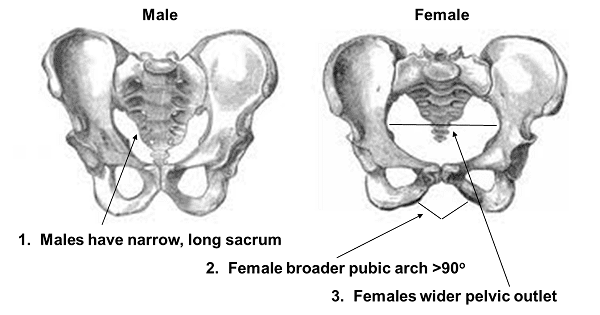
Sex Determination by Skeleton
| A | Capacity greater than 1500 cc | |
| B | Muscular markings over occiput are less marked | |
| C | Orbits are square | |
| D | Frontal eminence smal1 |
| A | Capacity greater than 1500 cc | |
| B | Muscular markings over occiput are less marked | |
| C | Orbits are square | |
| D | Frontal eminence smal1 |
|
|
Male |
Female |
|
General |
Larger, longer (Dolichocrania) |
Smaller, lighter (Brachycrania) |
|
Forehead |
Steeper, less rounded |
Vertical, rounded, full |
|
Glabella |
More Prominent |
Less prominent |
|
Frontonasal junction |
Distinct angulation |
Smoothly curved |
|
Orbits |
Square, rounded margins |
Rounded, sharp margins |
|
Zygomatic arch |
More Prominent |
Less prominent |
|
Frontal & Parietal eminences |
Small |
Large |
|
Occipital area |
Prominent |
Not prominent |
|
Palate |
Large, U-shaped |
Smaller, Parabola like |
|
Capacity |
1500 – 1550 cc. |
1350 – 1400 cc. |
| A | 3-year-old female | |
| B | 4-year-old male | |
| C | 14-year-old male | |
| D | 30-year-old female |
| A | 3-year-old female | |
| B | 4-year-old male | |
| C | 14-year-old male | |
| D | 30-year-old female |
Because the sub- pubic angle is about 60° and the pelvic brim is heart shaped, you are look ing at a male. The bones of the pelvis arise from three different centers of ossification and generally fuse together at about puberty through the twenty-third year, thus you know you have to be looking at a 14-year-old male, not a 3-year-old or an 80-year- old male.
You are examining the pelvic bone obtained from a shallow grave. You note that the preauricular sulcus is shallow and narrow without marked edge. Which of the following would be the MOST appropriate conclusion that you would come to regarding the above mentioned pelvis?
| A |
It is of a male |
|
| B |
It is of a female |
|
| C |
The individual was above 60 years |
|
| D |
The individual was above 50 years |
You are examining the pelvic bone obtained from a shallow grave. You note that the preauricular sulcus is shallow and narrow without marked edge. Which of the following would be the MOST appropriate conclusion that you would come to regarding the above mentioned pelvis?
| A |
It is of a male |
|
| B |
It is of a female |
|
| C |
The individual was above 60 years |
|
| D |
The individual was above 50 years |
The only thing that can be assumed from the above description is that it belonged to a male.
In females the preauricular sulcus is broad and deep especially in parous women.
The sex of an individual can be determined with an accuracy of 95% by examination of the pelvic bone alone.

What is the purpose of preauricular sulcus in identification of a dead body?
| A |
Determination of age |
|
| B |
Identification of sex |
|
| C |
Determination of race |
|
| D |
Cause of death |
What is the purpose of preauricular sulcus in identification of a dead body?
| A |
Determination of age |
|
| B |
Identification of sex |
|
| C |
Determination of race |
|
| D |
Cause of death |
Sex determination form pelvis possible upto 95°/oaccuracy from following except:
| A |
Greater sciatic notch |
|
| B |
Pre auricular sulcus |
|
| C |
Obturator foramen |
|
| D |
None |
Sex determination form pelvis possible upto 95°/oaccuracy from following except:
| A |
Greater sciatic notch |
|
| B |
Pre auricular sulcus |
|
| C |
Obturator foramen |
|
| D |
None |
D i.e. None
– In the Pelvis the traits seen are – Preauricular sulcus, Greater sciatic notch, Subpubic angle, pelvic brim or inlet, Body & ramus of pubiQ.
– Ilium, Acetabulam, Iileopectineal line, Ischeal tuberosity, Ischeopubic rami, Symphysis, Pelvic cavity, outlet, SI Joint, Sacrum, Coccyx, Ischepubic index & Sciatic notch index are also seen
Krogman’s formula is related to:
Odisha 11
| A |
Race |
|
| B |
Age |
|
| C |
Sex |
|
| D |
Stature |
Krogman’s formula is related to:
Odisha 11
| A |
Race |
|
| B |
Age |
|
| C |
Sex |
|
| D |
Stature |
Ans. Sex
Most useful for sex determination is:
Kerala 08
| A |
Skull |
|
| B |
Femur |
|
| C |
Pelvis |
|
| D |
Tibia |
Most useful for sex determination is:
Kerala 08
| A |
Skull |
|
| B |
Femur |
|
| C |
Pelvis |
|
| D |
Tibia |
Ans. Pelvis
Chilotic line helps in determination of:
| A |
Race |
|
| B |
Sex |
|
| C |
Age |
|
| D |
Stature |
Chilotic line helps in determination of:
| A |
Race |
|
| B |
Sex |
|
| C |
Age |
|
| D |
Stature |
Ans. Sex
Corporobasal index is used to determine:
AI 08
| A |
Age |
|
| B |
Sex |
|
| C |
Race |
|
| D |
Stature |
Corporobasal index is used to determine:
AI 08
| A |
Age |
|
| B |
Sex |
|
| C |
Race |
|
| D |
Stature |
Ans. Sex
Ilio-Pectineal line is used to determine difference in ‑
| A |
Sex |
|
| B |
Race |
|
| C |
Age |
|
| D |
None of the above |
Ilio-Pectineal line is used to determine difference in ‑
| A |
Sex |
|
| B |
Race |
|
| C |
Age |
|
| D |
None of the above |
Ans. is ‘a’ i.e., Sex
True about preauricular sulcus is
| A |
Used for determination of race |
|
| B |
Used for determination of stature |
|
| C |
Used for determination of sex |
|
| D |
None |
True about preauricular sulcus is
| A |
Used for determination of race |
|
| B |
Used for determination of stature |
|
| C |
Used for determination of sex |
|
| D |
None |
Ans. is ‘c’ i.e., Used for determination of sex
Sex can be determined by all except ‑
| A |
Preauricular sulcus |
|
| B |
Innominate bone |
|
| C |
Pelvic brim |
|
| D |
Coccyx |
Sex can be determined by all except ‑
| A |
Preauricular sulcus |
|
| B |
Innominate bone |
|
| C |
Pelvic brim |
|
| D |
Coccyx |
Ans. is ‘b’ i.e., Innominate bone
| Male | Female | |
| Preauricular sulcus Not | Not frequent, narrow, shallow | More frequent, broad & deep |
| Pelvic brim | Heart shaped | Circular or elliptical; more spacious; longer diameters |
| Coccyx | Less movable |
More movable |
Mandible of females has all the following feature except?
| A |
Ramus is less broad |
|
| B |
Angle of mandible is obtuse |
|
| C |
Inverted ramus |
|
| D |
Rounded symphysis mentii |
Mandible of females has all the following feature except?
| A |
Ramus is less broad |
|
| B |
Angle of mandible is obtuse |
|
| C |
Inverted ramus |
|
| D |
Rounded symphysis mentii |
All are seen in female mandible i.e., ramus with smaller breath, angle of body of mandible obtuse, ramus inverted,
and chin (symphysis mentis) rounded