Sheehan’s syndrome
A 35 years old mother of two children is suffering from amenorrhea for last 12 months. She has history of failure of lactation following 2nd delivery but remained asymptomatic thereafter. Skull X-ray shows “Empty sella”. Most likely diagnosis is:
| A |
Menopause |
|
| B |
Pituitary tumor |
|
| C |
Sheehan’s syndrome |
|
| D |
Intraductal papilloma of breast |
A 35 years old mother of two children is suffering from amenorrhea for last 12 months. She has history of failure of lactation following 2nd delivery but remained asymptomatic thereafter. Skull X-ray shows “Empty sella”. Most likely diagnosis is:
| A |
Menopause |
|
| B |
Pituitary tumor |
|
| C |
Sheehan’s syndrome |
|
| D |
Intraductal papilloma of breast |
Amenorrhea, failure of lactation and “Empty sella” in skull X-ray give the diagnosis of Sheehan’s syndrome.
Ref: Current Obs and Gynae Diagnosis and Treatment 8th Edition, Page 446 ;Internal Medicine: An Illustrated Radiological Guide By Jarrah Ali Al-Tubaikh, 2010, Page 247
A 32 year old women complains of amenorrhea since delivery of a baby 15 months previously, despite the fact that she did not breastfeed her baby. The delivery was complicated by excessive hemorrhage that required transfusion of 2.5 liters of blood. She has also been fatigued and has gained an additional 4.5Kg since the baby was born. Laboratory data show the following:
Serum LH < 1 IU/L (normal, 4-24 IU/L)
Serum estradiol 5 pg/mL (normal, 20 – 100 pg/mL)
Serum TSH 0.1 mU/L (normal, 0.5 – 5 mU/L)
Serum GH 3 ng/mL (normal, < 5 ng/mL)
Serum ACTH 28 pg/mL (normal, 10 – 50 pg/mL)
Serum prolactin 2 ng/mL (normal, Injection of 500 μg of TRH failed to produce the expected rise in both serum TSH and prolactin. Which of the following diagnoses most likely explains the findings in this patient?
| A |
Hashimoto’s thyroiditis |
|
| B |
Isolated gonadotropin deficiency |
|
| C |
Primary amenorrhea |
|
| D |
Sheehan’s syndrome |
A 32 year old women complains of amenorrhea since delivery of a baby 15 months previously, despite the fact that she did not breastfeed her baby. The delivery was complicated by excessive hemorrhage that required transfusion of 2.5 liters of blood. She has also been fatigued and has gained an additional 4.5Kg since the baby was born. Laboratory data show the following:
Serum LH < 1 IU/L (normal, 4-24 IU/L)
Serum estradiol 5 pg/mL (normal, 20 – 100 pg/mL)
Serum TSH 0.1 mU/L (normal, 0.5 – 5 mU/L)
Serum GH 3 ng/mL (normal, < 5 ng/mL)
Serum ACTH 28 pg/mL (normal, 10 – 50 pg/mL)
Serum prolactin 2 ng/mL (normal, Injection of 500 μg of TRH failed to produce the expected rise in both serum TSH and prolactin. Which of the following diagnoses most likely explains the findings in this patient?
| A |
Hashimoto’s thyroiditis |
|
| B |
Isolated gonadotropin deficiency |
|
| C |
Primary amenorrhea |
|
| D |
Sheehan’s syndrome |
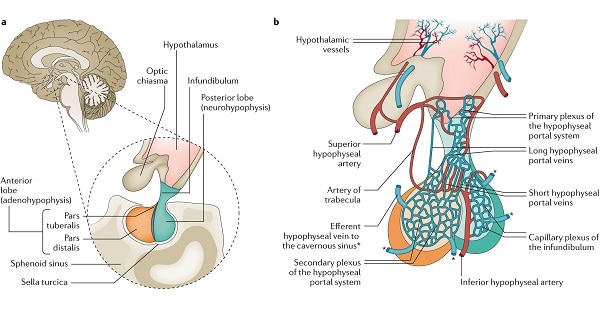
Sheehan’s syndrome is hypopituitarism due to ischemic damage to the pituitary resulting from excessive hemorrhage during parturition.
The pituitary is enlarged during pregnancy; it is more metabolically active, and more susceptible to hypoxemia.
Furthermore, the blood vessels in the pituitary may be more susceptible to vasospasm because of the high estrogen.
In about 30% of women who hemorrhage excessively during parturition, some degree of hypopituitarism eventually becomes manifest.
The symptoms depend on how much of the pituitary is damaged and what cell types are destroyed. The patient described above exhibited persistent amenorrhea after delivery of her infant.
This is due to destruction of pituitary gonadotrophs and diminished secretion of gonadotropins (LH).
There also appears to have been significant destruction of lactotrophs since TRH injection failed to induce an increase in prolactin.
Had the women attempted to breastfeed her infant, a failure to lactate mostly likely would have occurred.
This case is also characterized by secondary hypothyroidism.
The low TSH and failure to respond to TRH injection is confirmatory.
Corticotrophs appear to have been spared since plasma ACTH is normal.
It is not clear whether somatotrophs were damaged.
Further testing would be needed to see if GH reserve is diminished.
Hashimoto’s thyroiditis is an autoimmune disorder that produces primary hypothyroidism. Because of diminished negative feedback effects of T4, serum TSH is usually increased (not decreased).
Isolated gonadotropin deficiency produces amenorrhea and is associated with low serum LH and estradiol.
Hypogonadotropic hypogonadism can occur in female athletes that over-train, in anorexia nervosa, in obesity, or with other emotional or physical stresses.
However, other pituitary hormones are unaffected (by definition isolated gonadotropin deficiency only involves a decrease in gonadotropins).
Primary amenorrhea by definition, means failure of menstrual cycles to ever begin.
Since this woman has delivered a baby, primary amenorrhea is highly unlikely.
Ref: Cunningham F.G., Leveno K.J., Bloom S.L., Hauth J.C., Rouse D.J., Spong C.Y. (2010). Chapter 35. Obstetrical Hemorrhage. In F.G. Cunningham, K.J. Leveno, S.L. Bloom, J.C. Hauth, D.J. Rouse, C.Y. Spong (Eds), Williams Obstetrics, 23e.
A hypertensive primigravida developed Sheehan’s syndrome after the delivery. All of the following are seen with Sheehan’s syndrome, EXCEPT:
| A |
Obesity |
|
| B |
Amenorrhoea |
|
| C |
Failure to lactate |
|
| D |
Absence of secondary sexual characteristics |
A hypertensive primigravida developed Sheehan’s syndrome after the delivery. All of the following are seen with Sheehan’s syndrome, EXCEPT:
| A |
Obesity |
|
| B |
Amenorrhoea |
|
| C |
Failure to lactate |
|
| D |
Absence of secondary sexual characteristics |
Which drug is essential in Sheehan’s syndrome:
| A |
Estrogen |
|
| B |
Cortisone |
|
| C |
Thyroxin |
|
| D |
Growth hormone |
Which drug is essential in Sheehan’s syndrome:
| A |
Estrogen |
|
| B |
Cortisone |
|
| C |
Thyroxin |
|
| D |
Growth hormone |
Answer is B (Cortisone):
“Multiple hormones must be replaced in patients with pan-hypopituitarism, but cortisol replacement is most important”(2 – Harrison 14th /1994
Sheehan’s syndrome is post-partum infarction of the pituitary, leading to hypopituitarism.
Treatment consists of hormone replacement therapy including Glucocorticoids, Thyroid hormone, Sex steroids, Growth hormone, Vasopressin, etc. Thus, multiple hormones must be replaced, but remember that Cortisol replacement is most important.