


Thyroglossal Cyst
Most common site of thyroglossal cyst is?
| A | Subhyoid | |
| B |
Suprahyoid |
|
| C | Tongue | |
| D |
Subomohyoid |
Most common site of thyroglossal cyst is?
| A | Subhyoid | |
| B |
Suprahyoid |
|
| C | Tongue | |
| D |
Subomohyoid |
Subhyoid REF: Schwartz’s Principles of Surgery 9th edition Chapter 39. Pediatric Surgery
“Usually the thyroglossal cyst is encountered in the midline at or below the level of the hyoid bone and moves up and down with swallowing or with protrusion of the tongue”
The following statements about thyroglossal cyst are true, EXCEPT:
| A |
The cyst is located within 2 cm of the midline |
|
| B |
Incision and drainage is the treatment of choice |
|
| C |
The swelling moves upwards on protrusion of tongue |
|
| D |
It is the frequent cause of anterior midline neck masses in the first decade of life |
Thyroglossal cyst is a fluid filled sac resulting from a persistent thyroglossal duct.
Excision of the thyroglossal cyst along with the track and the body of the hyoid bone is the treatment of choice (Sistrunk’s operation).
Ref: Problem Based Approach in Pediatric Surgery By Rao, Page 108; Bailey and Love’s Short Practice of Surgery, 24th Edition, Pages 777-78.
A 16 year old girl presented with a painless swelling in the midline of the neck and moves up and down with swallowing and with protrusion of the tongue. Which is the most common site of thyroglossal cyst?
| A |
Subhyoid |
|
| B |
Suprahyoid |
|
| C |
Tongue |
|
| D |
Subomohyoid |
A 16 year old girl presented with a painless swelling in the midline of the neck and moves up and down with swallowing and with protrusion of the tongue. Which is the most common site of thyroglossal cyst?
| A |
Subhyoid |
|
| B |
Suprahyoid |
|
| C |
Tongue |
|
| D |
Subomohyoid |
Thyroglossal cyst arises from thyroglossal tract (extending from foramen caecum to isthmus of thyroid).
Most common site is subhyoid.
Other sites are thyroid and suprahyoid.
Typical presentation is painless, midline swelling in 15-30 years old female.
It is a soft, cystic, fluctuant, transillumination negative swelling.
It moves sideways, not vertically, with deglutition and protrusion of tongue (TUG due to attachment with hyoid).
Ref: Manual of Surgery: Essential Cases in Surgery By Sumit Chhikara, 2005, Page 58; Schwartz’s Principles of Surgery 9th edition, Chapter 39
A child presents with a midline swelling beneath the arch of the hyoid bone. What might this swelling be?
| A |
Thyroglossal cyst |
|
| B |
Sternocleidomastoid tumour |
|
| C |
Both of the above |
|
| D |
None of the above |
A child presents with a midline swelling beneath the arch of the hyoid bone. What might this swelling be?
| A |
Thyroglossal cyst |
|
| B |
Sternocleidomastoid tumour |
|
| C |
Both of the above |
|
| D |
None of the above |
In thyroglossal cyst, carcinoma which arises is
| A |
Follicular |
|
| B |
Medullary |
|
| C |
Papillary |
|
| D |
Anaplastic |
In thyroglossal cyst, carcinoma which arises is
| A |
Follicular |
|
| B |
Medullary |
|
| C |
Papillary |
|
| D |
Anaplastic |
Ans :C.), Papillary.
- Thyroglossal duct cysts are usually located in the midline of the neck. The coexistence of carcinomas in thyroglossal duct cysts is extremely rare, with most being papillary carcinomas.
- The definitive surgery of Thyroglossal Cyst is Sistrunk’s operation.
- There is still controversy regarding the need to remove the thyroid gland in the case of a papillary carcinoma of the Thyroglossal Duct Cyst.
- Thyroidectomy is recommended in cases where (a) the thyroid gland is found to be nodular, with a cold nodule in a thyroid iodine uptake scan; (b) enlarged lymph nodes are present, or (c) a history of neck irradiation exists .
For thyroglossal cyst M.C. site is –
| A |
Suprahyoid |
|
| B |
Subhyoid |
|
| C |
Foramen caecum |
|
| D |
Anterior border of sternomastoid |
For thyroglossal cyst M.C. site is –
| A |
Suprahyoid |
|
| B |
Subhyoid |
|
| C |
Foramen caecum |
|
| D |
Anterior border of sternomastoid |
Ans is B ie Subhyoid
- Thyroglossal cyst
- It is cystic swelling developed in the remnant of the thyroglossal duct or tract
- Site – It may be present in any part of the thyroglossal tract (thyroglossal tract extends from foramen caecum to the isthmus of thyroid)
- Common sites are:
subhyoid (most common)
in the region of the thyroid cartilages,
suprahyoid
in the floor of mouth
– beneath the foramen caecum
- It is a midline swelling, except in the region of the thyroid cartilage, where the thyroglossal tract is pushed to one side, usually to the left.
- Though its a congenital swelling most common age of presentation is between 2 to 4 yrs.
- Mobility – Cyst can be moved sideways but not vertically
- Peculiar characterstic which helps in distinguishing thyroglossal cyst from other neck swelling – it moves up with protrusion of tongue* as the thyroglossal tract is attached to the tongue.
– It also moves with degluttion so do all thyroid swellings, subhyoid bursitis, sublingual desmoid.
- Cyst is lined by pseudostratified columnar epithelium and squamous epithelium with hetrotopic thyroid tissue present in 20% of cases..
- Complications
– Recurrent infection,
– formation of thyroglossal fistula
– carcinomatous change (usually Papillary carcinoma. *)
- Treatment —> Treatment involves the “Sistrunk operation” which consists of enbloc cystectomy and excision of the central hyoid bone to minimize recurrence.
- Note
- Thyroglossal cyst is congenital but thyroglossal fistula is never congenital. It follows infection or inadequate removal of a thyroglossal cyst.
The following statements about thyroglossal cyst are true, except
| A |
Frequent cause of anterior midline neck masses in the first decade of life |
|
| B |
The cyst is located within 2 cm of the midline |
|
| C |
Incision and drainage is the treatment of choice |
|
| D |
The swelling moves upwards on protrusion of tongue |
Ans. is ‘c’ i.e. Incision and drainage is the treatment of choice
Treatment of thyroglossal cyst involves complete excision of cyst along with the thyroglossal tract. Incision and drainage can lead to fistula formation.
One of the following is an example of painless midline swelling –
| A |
Branchial cyst |
|
| B |
Thyroglossal cyst |
|
| C |
Cystic hygroma |
|
| D |
Carotid body tumour |
One of the following is an example of painless midline swelling –
| A |
Branchial cyst |
|
| B |
Thyroglossal cyst |
|
| C |
Cystic hygroma |
|
| D |
Carotid body tumour |
Ans is ‘b’ ie Thyroglossal cyst
|
Midline swelling of neck from above downwards |
||
|
1. Ludwigs angina 7. Goitre |
||
|
2. Enlarged submental lymph nodes |
8. Lipoma & enlarged lymph nodes in the suprasternal space of |
|
|
3. Sublingual dermoid |
burns |
|
|
4. Lipoma in submental region |
9. Retrosternal goitre |
|
|
5. Thyroglossal cyst |
10. Thymic swelling |
|
|
6. Subhyoid bursitis |
11. (A dermoid cyst may occur anywhere in the midline) |
|
Hyoid bone is closely associated with –
| A |
Bronchiogenic cyst |
|
| B |
Cystic hygroma |
|
| C |
Thyroglossal cyst/fistula |
|
| D |
Branchial cyst |
Hyoid bone is closely associated with –
| A |
Bronchiogenic cyst |
|
| B |
Cystic hygroma |
|
| C |
Thyroglossal cyst/fistula |
|
| D |
Branchial cyst |
Ans is ‘c’ i.e., Thyroglossal cyst
Hyoid bone is closely associated with the thyroglossal tract from which thyroglossal cyst & fistula originate, thus during surgical excision of the thyroglossal cyst or fistula, the central part of the hyoid bone is excised (otherwise recurrence may occur).
In the management of thyroglossal cyst ‑
| A |
Central portion of hyoid excised |
|
| B |
Sternothyroid muscle dissected |
|
| C |
Isthmusectomy with subtotal thyroidectomy |
|
| D |
Strap muscle of neck are dissected |
In the management of thyroglossal cyst ‑
| A |
Central portion of hyoid excised |
|
| B |
Sternothyroid muscle dissected |
|
| C |
Isthmusectomy with subtotal thyroidectomy |
|
| D |
Strap muscle of neck are dissected |
Answer is ‘a’ i.e. Central portion of hyoid excised
Thyroglossal cyst is managed by Sistrunk operation in which the cyst is completely excised along with the thyroglossal tract. Since the thyroglossal tract is intimately related to the hyoid bone, the central portion of the hyoid bone is also removed.
Most common site for thyroglossal cyst is ‑
| A |
Suprahyoid |
|
| B |
Subhyoid |
|
| C |
Beneath the foramen ceacum |
|
| D |
Floor of mouth |
Most common site for thyroglossal cyst is ‑
| A |
Suprahyoid |
|
| B |
Subhyoid |
|
| C |
Beneath the foramen ceacum |
|
| D |
Floor of mouth |
Ans. is ‘b’ i.e., Subhyoid
Sistrunk’s operation is used in
| A |
Parotid tumour |
|
| B |
Thyroglossal fistula |
|
| C |
Thyroglossal cyst |
|
| D |
b and c |
Sistrunk’s operation is used in
| A |
Parotid tumour |
|
| B |
Thyroglossal fistula |
|
| C |
Thyroglossal cyst |
|
| D |
b and c |
Ans. Two options are correct i.e., ‘b’ i.e. Thyroglossal fistula & ‘c’ i.e. Thyroglossal cyst
Excision of the hyoid bone is done in –
| A |
Branchial cyst |
|
| B |
Branchial fistula |
|
| C |
Thyroglossal cyst |
|
| D |
Sublingual dermoids |
Excision of the hyoid bone is done in –
| A |
Branchial cyst |
|
| B |
Branchial fistula |
|
| C |
Thyroglossal cyst |
|
| D |
Sublingual dermoids |
Ans. is ‘c’ i.e., Thyroglossal cyst
Which of the following does not move on deglutition
| A |
Subligual dermoid |
|
| B |
Thyroid nodule |
|
| C |
Pretracheallymphnode |
|
| D |
Thyroglossal cyst |
Which of the following does not move on deglutition
| A |
Subligual dermoid |
|
| B |
Thyroid nodule |
|
| C |
Pretracheallymphnode |
|
| D |
Thyroglossal cyst |
Ans. is ‘a’ i.e., Subligual dermoid
Not sure about option ‘c’ but answer ‘a’ is confirmed
Thyroglossal fistula develops due to –
| A |
Developmental anomaly |
|
| B |
Injury |
|
| C |
Incomplete removal of thyroglossal cyst |
|
| D |
Inflammatory disorder |
Thyroglossal fistula develops due to –
| A |
Developmental anomaly |
|
| B |
Injury |
|
| C |
Incomplete removal of thyroglossal cyst |
|
| D |
Inflammatory disorder |
Ans. is ‘c’ i.e., Incomplete removal of thyroglossal cyst
Thyroglossal fistula is never congenital. It follows infection or inadequate removal of a thyroglossal cyst.
Which is never a cause of thyroglossal fistula ‑
| A |
Infection of thyroglossal cyst |
|
| B |
Inadequate removal of thyroglossal cyst |
|
| C |
Congenital |
|
| D |
None of the above |
Which is never a cause of thyroglossal fistula ‑
| A |
Infection of thyroglossal cyst |
|
| B |
Inadequate removal of thyroglossal cyst |
|
| C |
Congenital |
|
| D |
None of the above |
Ans. is ‘c’ i.e., Congenital
Which of the following swelling moves on protrusion of tongue –
| A |
Thyroglossal cyst |
|
| B |
Branchial cyst |
|
| C |
Ranula |
|
| D |
Cyst in hyoid bone |
Which of the following swelling moves on protrusion of tongue –
| A |
Thyroglossal cyst |
|
| B |
Branchial cyst |
|
| C |
Ranula |
|
| D |
Cyst in hyoid bone |
Ans. is ‘a’ i.e., Thyroglossal cyst
Hyoid bone is closely associated to:
September 2012
| A |
Bronchogenic cyst |
|
| B |
Cystic hygroma |
|
| C |
Thyroglossal cyst |
|
| D |
Ranula |
Hyoid bone is closely associated to:
September 2012
| A |
Bronchogenic cyst |
|
| B |
Cystic hygroma |
|
| C |
Thyroglossal cyst |
|
| D |
Ranula |
Ans. C i.e. Thyroglossal cyst
Thyroglossal cyst
MC site:
– Beneath the hyoid,
Occupies the midline usually (except in the region of thyroid cartilage),
- Swelling moves upwards on protrusion of the tongue as well as on swallowing (attachment with foramen caecum),
- Painless
MC site for thyroglossal cyst is:
March 2013 (a, d, g, h)
| A |
Beneath the foramen caecum |
|
| B |
Floor of mouth |
|
| C |
Above hyoid |
|
| D |
Subhyoid |
MC site for thyroglossal cyst is:
March 2013 (a, d, g, h)
| A |
Beneath the foramen caecum |
|
| B |
Floor of mouth |
|
| C |
Above hyoid |
|
| D |
Subhyoid |
Ans. D i.e. Subhyoid
Anterior m i d line swelling of neck is:
March 2013 (g)
| A |
Branchial cyst |
|
| B |
Thyroglossal cyst |
|
| C |
Cystic hygroma |
|
| D |
Carotid body tumour |
Anterior m i d line swelling of neck is:
March 2013 (g)
| A |
Branchial cyst |
|
| B |
Thyroglossal cyst |
|
| C |
Cystic hygroma |
|
| D |
Carotid body tumour |
Ans. B i.e. Thyroglossal cyst
Most common malignancy arising in thyroglossal cyst is
| A |
Follicular |
|
| B |
Papillary |
|
| C |
Medullary |
|
| D |
Anaplastic |
Most common malignancy arising in thyroglossal cyst is
| A |
Follicular |
|
| B |
Papillary |
|
| C |
Medullary |
|
| D |
Anaplastic |
Thvroglossal Cyst
- Contains clear to cloudy fluid with sparse cellularity.
- Cystic background contains few if any epithelial cells.
- Some inflammatory cells and crystals might be present.
- Rarely malignant transformation occurs in about 1% of the cases.
- Most common malignancy arising is papillary carcinoma followed by squamous cell carcinoma.
In the management of the condition “marked by a red arrow” in the reconstructed CT scan of the neck as shown in the picture below ? 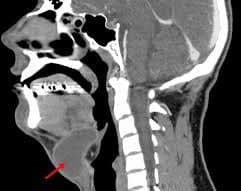

| A |
Central portion of hyoid excised. |
|
| B |
Sternothyroid muscle dissected. |
|
| C |
Isthmusectomy with subtotal thyroidectomy. |
|
| D |
Strap muscle of neck are dissected. |
In the management of the condition “marked by a red arrow” in the reconstructed CT scan of the neck as shown in the picture below ?
| A |
Central portion of hyoid excised. |
|
| B |
Sternothyroid muscle dissected. |
|
| C |
Isthmusectomy with subtotal thyroidectomy. |
|
| D |
Strap muscle of neck are dissected. |
Reconstructed CT scan of the neck as shown in the picture above demonstrates a midline cystic lesion i.e Thyroglossal duct cyst with a slightly enhancing wall.
In the management of thyroglossal cyst, the central portion of hyoid is excised.
Thyroglossal cyst is managed by Sistrunk operation in which the cyst is completely excised along with the thyroglossal tract. Since the thyroglossal tract is intimately related to the hyoid bone, the central portion of the hyoid bone is also removed.

