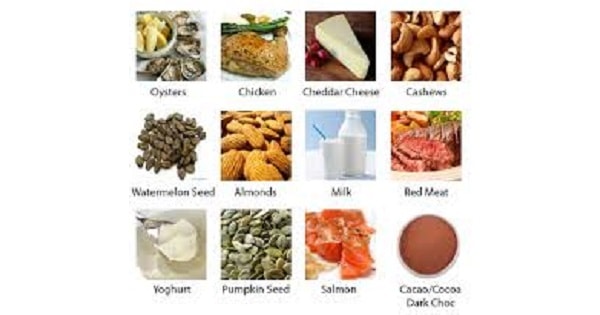
Trace element:Zinc
| A | Ca | |
| B | Chromium | |
| C | Cobalt | |
| D | Zinc |
| A | Ca | |
| B | Chromium | |
| C | Cobalt | |
| D | Zinc |
Zinc deficiency is marked by an eczematoid rash either diffusely or in intertriginous areas. A microcytic anemia can develop from a lack of copper and glucose intolerance and may be associated with a lack of chromium. Daily administration of trace metal supplements obviates these problems.
| A |
Prostate |
|
| B | Skin | |
| C |
Hair |
|
| D |
Bone |
| A |
Prostate |
|
| B | Skin | |
| C |
Hair |
|
| D |
Bone |
Prostate REF: Trace element analysis in biological specimens by R. F. M. Herber, Markus Stoeppler page 551
|
Tissue |
Mean concentration of Zinc |
|
Adrenal |
43.2 |
|
Bone |
94 |
|
Brain |
39 |
|
Heart |
87 |
|
Skin |
25 |
|
Prostate |
243 |
|
Muscle |
200 |
|
Liver |
169 |
|
Kidney |
188 |
| A |
8 mg/day |
|
| B |
9.4 mg/day |
|
| C |
11mg/day |
|
| D |
15mg/day |
| A |
8 mg/day |
|
| B |
9.4 mg/day |
|
| C |
11mg/day |
|
| D |
15mg/day |
9.4 mg/day REF: Ganong’s 22nd ed p. 314
|
|
Male |
Female |
|
Daily requirement |
9.4 mg/d |
6.8 mg/d |
|
RDA |
llmg/d |
8mg/d |
Dose of zinc used in acrodermatitis enteropathica is?
| A |
0.5mg/kg |
|
| B |
2mg/kg |
|
| C |
5mg/kg |
|
| D |
7mg/kg |
Dose of zinc used in acrodermatitis enteropathica is?
| A |
0.5mg/kg |
|
| B |
2mg/kg |
|
| C |
5mg/kg |
|
| D |
7mg/kg |
Dose of zinc for acrodermatitis enteropathica is 2-3 mg/kg body weight
| A | Pyruvate dehydrogenase | |
| B | Pyruvate decarboxylase | |
| C | a-keto glutarate dehydrogenase | |
| D | Alcohol dehydrogenase |
| A | Pyruvate dehydrogenase | |
| B | Pyruvate decarboxylase | |
| C | a-keto glutarate dehydrogenase | |
| D | Alcohol dehydrogenase |
Alcohol dehydrogenase [Ref: Chatterje Shinde Biochemistery 6/e p551]
Zinc containing enzymes are:
1) Superoxide dismutase (it is a Cu-Zn protein complex)
2) Carbonic anhydrase
3) Leucine amino peptidase
4) Carboxy peptides ‘A’
5) Alcohol dehydrogenase
6) Retinine reductase
7) Alkaline phosphatase
8) Glutamate dehydrogenase
9) Lactate dehydrogenase
10) DNA and RNA polymerase
11) d-ALA dehydratase
| A | Zinc | |
| B | Copper | |
| C | Manganese | |
| D | Chromium |
| A | Zinc | |
| B | Copper | |
| C | Manganese | |
| D | Chromium |
Zinc
A 6 month old child presented with diarrhea for few days. He had dermatitic lesions on his hands and feet. Scalp hair was comparatively less. Deficiency of zinc was suspected. TRUE about acrodermatitis enteropathica is:
| A |
Autosomal recessive |
|
| B |
Autosomal dominant |
|
| C |
Zinc treatment cures partially |
|
| D |
Treatment life long |
A 6 month old child presented with diarrhea for few days. He had dermatitic lesions on his hands and feet. Scalp hair was comparatively less. Deficiency of zinc was suspected. TRUE about acrodermatitis enteropathica is:
| A |
Autosomal recessive |
|
| B |
Autosomal dominant |
|
| C |
Zinc treatment cures partially |
|
| D |
Treatment life long |
Acrodermatitis enteropathica (AE):
- It is an autosomal recessive disorder of zinc absorption.
- It presents in infancy, characterized by a triad of acral dermatitis (face, hands, feet, anogenital area), alopecia, and diarrhea.
- These infants have a defect in an intestinal zinc transporter, the human ZIP4 protein encoded on the SLC39A4 gene.
- Mutations in this gene prevents appropriate enteral zinc absorption.
- AE classically presents during infancy on weaning from breast milk to formula or cereal, which have lower zinc bioavailability than breast milk.
All are advantages of Zinc therapy for Wilson disease except:
| A |
It is nontoxic |
|
| B |
Produces positive copper balance |
|
| C |
Blocks intestinal absorption of copper |
|
| D |
Induces hepatic metallothionein synthesis |
All are advantages of Zinc therapy for Wilson disease except:
| A |
It is nontoxic |
|
| B |
Produces positive copper balance |
|
| C |
Blocks intestinal absorption of copper |
|
| D |
Induces hepatic metallothionein synthesis |
Zinc treatment in wilson disease:
- It is efficient in Wilson’s disease
- Nontoxic
- Produces a negative copper balance by blocking intestinal absorption of copper
- It induces hepatic metallothionein synthesis, which sequesters additional toxic copper
Micronutrient associated with rash and diarrhea is:
| A |
Manganese |
|
| B |
Copper |
|
| C |
Zinc |
|
| D |
Iron |
Micronutrient associated with rash and diarrhea is:
| A |
Manganese |
|
| B |
Copper |
|
| C |
Zinc |
|
| D |
Iron |
Acrodermatitis enteropathica is a rare autosomal recessive disorder caused by an inability to absorb sufficient zinc from diet.
The cutaneous eruption consists of vesicio-bullous, eczematous, dry scaly or psoriasisiform skin lesions symmetrically distributed in body. Associated manifestations include chronic, stomatitis, glossitis, paronychia and superinfection with candida albicans.
Dose of zinc recommended for 9 month old during acute diarrhoea is:
| A |
5 mg daily |
|
| B |
10 mg daily |
|
| C |
20 mg daily |
|
| D |
25 mg daily |
Dose of zinc recommended for 9 month old during acute diarrhoea is:
| A |
5 mg daily |
|
| B |
10 mg daily |
|
| C |
20 mg daily |
|
| D |
25 mg daily |
Zinc supplement given during an acute diarrhoea episode reduces severity and duration of disease.
WHO and UNICEF recommend that children 6 months be given 20 mg daily.
The recommended duration for treatment is for 10 to 14 days.
Ref: Park 21st edition, page 204.
Which of the following micronutients have a role in regulation of binding of proteins to DNA?
| A |
Zinc |
|
| B |
Copper |
|
| C |
Selenium |
|
| D |
Nickel |
Which of the following micronutients have a role in regulation of binding of proteins to DNA?
| A |
Zinc |
|
| B |
Copper |
|
| C |
Selenium |
|
| D |
Nickel |
Protein–DNA interactions are regulated by several motifs which includes Helix turn–Helix motif, Zinc finger motif and Leucine Zipper motif.
All of the following functions requires Zinc as a micro-element, EXCEPT:
| A |
Spermatogenesis |
|
| B |
Fetal growth |
|
| C |
Embryonic development |
|
| D |
Melanin synthesis |
All of the following functions requires Zinc as a micro-element, EXCEPT:
| A |
Spermatogenesis |
|
| B |
Fetal growth |
|
| C |
Embryonic development |
|
| D |
Melanin synthesis |
Note: Zinc is absolutely required for normal spermatogenesis, fetal growth, and embryonic development.
Zinc is also an integral component of many metalloenzymes. It is involved in the synthesis and stabilization of proteins, DNA, and RNA and plays a structural role in ribosomes and membranes.
Copper plays an important role in iron metabolism, melanin synthesis, energy production, neurotransmitter synthesis, CNS function, the synthesis and cross-linking of elastin and collagen and the scavenging of superoxide radicals
Ref: Russell R.M., Suter P.M. (2012). Chapter 74. Vitamin and Trace Mineral Deficiency and Excess. In D.L. Longo, A.S. Fauci, D.L. Kasper, S.L. Hauser, J.L. Jameson, J. Loscalzo (Eds), Harrison’s Principles of Internal Medicine, 18e.
Trace element present in carbonic anhydrase is?
| A |
Zinc |
|
| B |
Molybdenum |
|
| C |
Copper |
|
| D |
Magnesium |
Trace element present in carbonic anhydrase is?
| A |
Zinc |
|
| B |
Molybdenum |
|
| C |
Copper |
|
| D |
Magnesium |
Zn is an essential component of several enzymes like carbonic anhydrase, alcohol dehydrogenase, alkaline phosphatase, carboxypeptidase and superoxaide dismutase.
What is the daily requirement of zinc in humans ?
| A |
8 mg/day |
|
| B |
9.4 mg/day |
|
| C |
11 mg/day |
|
| D |
15 mg/day |
What is the daily requirement of zinc in humans ?
| A |
8 mg/day |
|
| B |
9.4 mg/day |
|
| C |
11 mg/day |
|
| D |
15 mg/day |
Daily requirement of Zinc for adult men is 9.4mg/d and for women is 6.8mg/d.
- RDA for zinc in males and females are 11mg and 8mg.
- RDA for Zinc during pregnancy is 11mg/d
- Zinc recommendation for lactating women is 12mg/d.
- Features of zinc deficiency in children are growth retardation, skeletal abnormalities, poor wound healing, diarrhea, skin rash and delayed sexual maturation.
Which of the following organs secretes zinc in large amount in man?
| A |
Seminal vesicle |
|
| B |
Prostate |
|
| C |
Epididymis |
|
| D |
Vas |
Which of the following organs secretes zinc in large amount in man?
| A |
Seminal vesicle |
|
| B |
Prostate |
|
| C |
Epididymis |
|
| D |
Vas |
Prostate contributes 20% of the total volume of the semen. Secretion from the prostate contains the following:
- Spermine
- Citric acid
- Cholesterol, phospholipids
- Fibrinolysin, fibrinogenase
- Zinc
- Acid phosphatase
- Fructose
- Phosphorylcholine
- Ergothioneine
- Ascorbic acid
- Flavins
- Prostaglandins
Zinc acts as co-factor in:
| A |
Lactate dehydrogenase |
|
| B |
Carbonic anhydrase |
|
| C |
Alkaline phosphatase |
|
| D |
All |
Zinc acts as co-factor in:
| A |
Lactate dehydrogenase |
|
| B |
Carbonic anhydrase |
|
| C |
Alkaline phosphatase |
|
| D |
All |
Paneth cells contain –
| A |
Zinc |
|
| B |
Copper |
|
| C |
Molybdenum |
|
| D |
Selenium |
Paneth cells contain –
| A |
Zinc |
|
| B |
Copper |
|
| C |
Molybdenum |
|
| D |
Selenium |
Ans. is ‘a’ i.e., Zinc
o Paneth cells are zinc-containing cells widely distributed in Lieberkuhn’s crypts of intestine in a variety of species. o These cells have atypically orietned bright eosinophilic granules containing a variety of antimicroial proteins and play a role in mucosal immunity (and not mucin secretion).
o The principle defense molecule secreted by Paneth cells are alpha-defensins.
o In addition to defensins, Paneth cells secrete lysozyme, TNF-a, and phospholipase-A2.
Metal fume fever is common in chronic poisoning with:
| A |
Mercury |
|
| B |
Lead |
|
| C |
Zinc |
|
| D |
Thallium |
Metal fume fever is common in chronic poisoning with:
| A |
Mercury |
|
| B |
Lead |
|
| C |
Zinc |
|
| D |
Thallium |
C i.e. Zinc
A person presents to the emergency with rigors and chills and a clinical picture resembling malaria , which of the following poisoning is likely‑
| A |
Mercury |
|
| B |
Red phosphorous |
|
| C |
Zinc |
|
| D |
Arsenic |
A person presents to the emergency with rigors and chills and a clinical picture resembling malaria , which of the following poisoning is likely‑
| A |
Mercury |
|
| B |
Red phosphorous |
|
| C |
Zinc |
|
| D |
Arsenic |
C i.e. Zinc
Zinc deficiency causes –
| A |
Sexual infantilism |
|
| B |
Loss of libido |
|
| C |
Poor weight gain |
|
| D |
All |
Zinc deficiency causes –
| A |
Sexual infantilism |
|
| B |
Loss of libido |
|
| C |
Poor weight gain |
|
| D |
All |
Ans. is All
Hypogonadism (sexual infantilism, loss of libido), poor weight gain (growth retardation) and poor wound healing are seen in zinc deficiency.
Diarrhoea in a child of 12 month, dose of Zinc is ‑
| A |
1 mg / 10 – 14 day |
|
| B |
10 mg / 10 – 14 day |
|
| C |
15 mg/ 10- 14 day |
|
| D |
20 mg / 10 – 14 day |
Diarrhoea in a child of 12 month, dose of Zinc is ‑
| A |
1 mg / 10 – 14 day |
|
| B |
10 mg / 10 – 14 day |
|
| C |
15 mg/ 10- 14 day |
|
| D |
20 mg / 10 – 14 day |
Ans. is ‘d’ i.e., 20 mg/10-14 days
According to WHO guidlines
Dose of Zinc
2 month – 6 month = 10 mg / day x 14 days > 6 months = 20 mg/day x 14 days
Growth retardation, taste alteration, hepatosplenomegly, hypochromic microcytic anemia, loss of hair, hypogonadism in a boy indicate deficiency of-
| A |
Selenium |
|
| B |
Copper |
|
| C |
Zinc |
|
| D |
Iron |
Growth retardation, taste alteration, hepatosplenomegly, hypochromic microcytic anemia, loss of hair, hypogonadism in a boy indicate deficiency of-
| A |
Selenium |
|
| B |
Copper |
|
| C |
Zinc |
|
| D |
Iron |
Ans. is ‘c’ i.e., Zinc
Deficiency of which element can lead to syndrome of growth failure, anaemia and hypogonadism ‑
| A |
Calcium |
|
| B |
Copper |
|
| C |
Zinc |
|
| D |
Magnesium |
Deficiency of which element can lead to syndrome of growth failure, anaemia and hypogonadism ‑
| A |
Calcium |
|
| B |
Copper |
|
| C |
Zinc |
|
| D |
Magnesium |
Ans. is ‘c’ i.e., Zinc
Dermatitis and alopecia are due to deficiency of:
| A |
Zinc |
|
| B |
Molybodenum |
|
| C |
Magnesium |
|
| D |
Calcium |
Dermatitis and alopecia are due to deficiency of:
| A |
Zinc |
|
| B |
Molybodenum |
|
| C |
Magnesium |
|
| D |
Calcium |
A i.e. Zinc
Hypogonadism, reduced immunity and alopecia may be a deficiency manifestation of:
September 2012
| A |
Iron |
|
| B |
Copper |
|
| C |
Zinc |
|
| D |
Magnesium |
Hypogonadism, reduced immunity and alopecia may be a deficiency manifestation of:
September 2012
| A |
Iron |
|
| B |
Copper |
|
| C |
Zinc |
|
| D |
Magnesium |
Ans: C i.e. Zinc
Manifestations of Zinc deficiency
- Primary T-cell lymphocyte immune system dysfunction (leading to failure to terminate incipient malignancies, viral and fungal infections);
- Frequent opportunistic infections (due to inability to protect cell membranes from viruses, toxins, complement, and venoms);
- Respiratory and skin allergies,
- Asthma;
- Chronic diarrhea;
- Abnormal neurosensory changes,
- Poor appetite (particularly in the young and aged);
- Mental lethargy,
- Fertility problems (including hypogonads, failure of sexual maturity, benign prostatitis in men, and menstrual cramping and bloating in women),
- Birth defects;
- Growth failure (dwarfism) and growth retardation;
- Premature aging;
- Vision problems;
- Loss of taste;
- Joint pain;
- Essential hypertension;
- Angina pectoris;
- Ischemia of effort;
- Delayed wound healing;
- Scleroderma;
- Systemic scleroderma (including lethal pulmonary hypertension);
- Loss of hair color;
- Anemia;
- Striae (stretch marks);
- Night blindness;
- Acne; and
- Defective connective tissue and macular degeneration; and
- Apathy and irritability.
Deficiency of zinc causes all of the following except:
March 2010
| A |
Growth retardation |
|
| B |
Sexual infantilism |
|
| C |
Alopecia |
|
| D |
None |
Deficiency of zinc causes all of the following except:
March 2010
| A |
Growth retardation |
|
| B |
Sexual infantilism |
|
| C |
Alopecia |
|
| D |
None |
Ans. D i.e. None
Which of the following is false regarding acrodermatitis enteropathica:
| A |
Low serum zinc levels |
|
| B |
Triad of diarrhea, dementia and dermatitis |
|
| C |
Autosomal recessive condition |
|
| D |
None of the above |
Which of the following is false regarding acrodermatitis enteropathica:
| A |
Low serum zinc levels |
|
| B |
Triad of diarrhea, dementia and dermatitis |
|
| C |
Autosomal recessive condition |
|
| D |
None of the above |
Ans. B: Triad of diarrhea, dementia and dermatitis
Acrodermatitis enteropathica is a rare inherited form of zinc deficiency, characterized by:
- Periorificial and Acral Dermatitis
- Alopecia
- Diarrhea
Symptoms of Zinc Deficiency
- Poor Immune system
- Weight loss
- Intercurrent infections
- Hypogonadism in males
- Lack of sexual development in females
- Growth retardation
- Dwarfism
- Delayed puberty in adolescents
- Rough skin
- Poor appetite
- Mental lethargy
- Delayed wound healing
- Short stature
- Diarrhea
One easily recognized sign which may be caused by zinc deficiency is white spots, bands, or lines on fingernails (leukonychia).
Some women may have multiple parallel white bands or lines on the fingernails marking menstrual cycles when marginal zinc deficiency was present.
Zinc is not required for:
March 2011
| A |
Embryonic development |
|
| B |
Coagulation pathway |
|
| C |
DNA synthesis |
|
| D |
Spermatogenesis |
Zinc is not required for:
March 2011
| A |
Embryonic development |
|
| B |
Coagulation pathway |
|
| C |
DNA synthesis |
|
| D |
Spermatogenesis |
Ans. B: Coagulation Pathway
Severe maternal zinc deficiency has been associated with congenital malformations or spontaneous abortions Zinc deficiency has been reported to result in sexual infantilism (zinc is required for proper reproduction) Zinc is required for wound healing. Zinc enhances cell growth and division.
Zinc
- Zinc is found in nearly 100 specific enzymes, serves as structural ions in transcription factors and is stored and transferred in metallothioneins.
- It is “typically the second most abundant transition metal in organisms” after iron and it is the only metal which appears in all enzyme classes.
- In proteins, Zn ions are often coordinated to the amino acid side chains of aspartic acid, glutamic acid, cysteine and histidine.
- There are 2-4 grams of zinc distributed throughout the human body.
- Most zinc is in the brain, muscle, bones, kidney, and liver, with the highest concentrations in the prostate and parts of the eye.
- Semen is particularly rich in zinc, which is a key factor in prostate gland function and reproductive organ growth.
- In humans, zinc plays “ubiquitous biological roles”.
- It interacts with “a wide range of organic ligands”, and has roles in the metabolism of RNA and DNA, signal transduction, and gene expression.
- It also regulates apoptosis.
- In the brain, zinc is stored in specific synaptic vesicles by glutamatergic neurons and can “modulate brain excitability”.
- It plays a key role in synaptic plasticity and so in learning.
- However it has been called “the brain’s dark horse” since it also can be a neurotoxin, suggesting zinc homeostasis plays a critical role in normal functioning of the brain and central nervous system.
- Zinc is an efficient Lewis acid, making it a useful catalytic agent in hydroxylation and other enzymatic reactions.
- The metal also has a flexible coordination geometry, which allows proteins using it to rapidly shift conformations to perform biological reactions.
- Two examples of zinc-containing enzymes are carbonic anhydrase and carboxypeptidase, which are vital to the processes of carbon dioxide (CO2) regulation and digestion of proteins, respectively.
A person presents with acute poisoning, with chills and rigors similar to malaria. Most likely poisoning is with:
AIIMS 06
| A |
Mercury |
|
| B |
Zinc |
|
| C |
Red phosphorus |
|
| D |
Arsenic |
A person presents with acute poisoning, with chills and rigors similar to malaria. Most likely poisoning is with:
AIIMS 06
| A |
Mercury |
|
| B |
Zinc |
|
| C |
Red phosphorus |
|
| D |
Arsenic |
Ans. Zinc
Zinc is essential for ‑
| A |
Pyruvate lrinase |
|
| B |
Cytochrome oxidase |
|
| C |
Xanthine oxidase |
|
| D |
Carbonic anhydrase |
Zinc is essential for ‑
| A |
Pyruvate lrinase |
|
| B |
Cytochrome oxidase |
|
| C |
Xanthine oxidase |
|
| D |
Carbonic anhydrase |
RDA of zinc in a child ‑
| A |
10 mg |
|
| B |
20 mg |
|
| C |
6-8 mg |
|
| D |
4-5 mg |
RDA of zinc in a child ‑
| A |
10 mg |
|
| B |
20 mg |
|
| C |
6-8 mg |
|
| D |
4-5 mg |
Ans. is ‘c’ i.e., 6-8 mg