
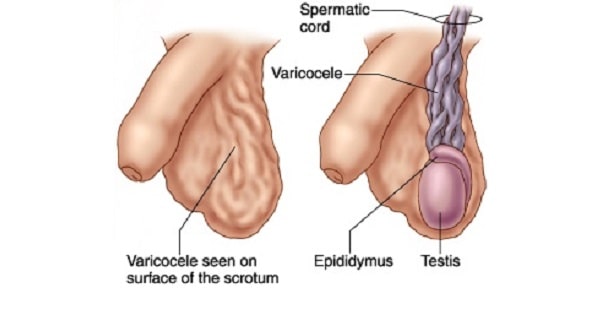
Varicocele
All of the following are true about varicocele, EXCEPT:
| A |
Common on the right side |
|
| B |
Can present as a late sign of renal cell carcinoma |
|
| C |
Has bag of worm like feeling |
|
| D |
Can lead to infertility |
All of the following are true about varicocele, EXCEPT:
| A |
Common on the right side |
|
| B |
Can present as a late sign of renal cell carcinoma |
|
| C |
Has bag of worm like feeling |
|
| D |
Can lead to infertility |
Varicocele is due to abnormal dilation of spermatic cord veins, also known as the pampiniform plexus, due to faulty valvular venous return.
Most varicoceles occur on the left, possibly due in part to the acute angle of confluence with the left renal vein and resulting higher IV pressure.
Classically, the mass of enlarged veins can be palpated superior and posterior to the testis (“bag of worms”), and is more prominent when standing or with Valsalva maneuver.
The sudden onset of a right varicocele should raise the question of a retroperitoneal malignancy resulting in obstruction of the right spermatic vein. Varicocele may lead to infertility in some men.
Which of the following is true regarding Renal Cell Carcinoma?
| A |
More common in males |
|
| B |
May cause varicocele |
|
| C |
May invade the renal vein |
|
| D |
All the above |
Which of the following is true regarding Renal Cell Carcinoma?
| A |
More common in males |
|
| B |
May cause varicocele |
|
| C |
May invade the renal vein |
|
| D |
All the above |
Renal Cell Carcinoma arises from the PCT and is usually polar in location. The tissue of origin for renal cell carcinoma (RCC) is the proximal renal tubular epithelium. It is more common in males. The classic triad of flank pain, hematuria, and flank mass. The most common presentations include hematuria (40%). Other signs and symptoms include weight loss (33%), fever (20%), hypertension (20%), hypercalcemia (5%), night sweats, malaise, and a varicocele, usually left sided, due to obstruction of the testicular vein (2% of males).
False regarding hypernephroma is –
| A |
Radiosensitive |
|
| B |
Arise from cortex usually from pre existing adenoma |
|
| C |
May present with rapidly developing varicocele |
|
| D |
Usually adenocarcinoma |
False regarding hypernephroma is –
| A |
Radiosensitive |
|
| B |
Arise from cortex usually from pre existing adenoma |
|
| C |
May present with rapidly developing varicocele |
|
| D |
Usually adenocarcinoma |
Ans. is ‘a’ i.e., Radiosensitive
RCC or hypernephroma is one of the most radioresistant and chemoresistant tumors.
In men rapidly developing varicocele is rare but impressive sign for RCC occuring most often on the left side. It occurs because left gonadal vein is obstructed where it joins the left renal vein.
As already stated RCC originates in the cortex and tends to grow out into perinephric tissue causing characteristic bulge or mass effect.
About adenomas
Adenomas are the most common benign renal parenchymal lesions.
– Despite the classification of adenoma as a benign tumor, no clinical, histologic or immunohistochemical criteria can differentiate renal adenoma from renal carcinoma.
- Smith’s Urology writes about adenomas ‑
– “Previously, all renal tumors less than 3 cm were considered adenomas. However, even such small tumors can metastasize and are now classified as renal cell carcinoma. Adenomas of any size should be treated as a fortuitous finding representative of an early renal cancer, and the patient should be evaluated and treated appropriately.”
Not correct regarding Renal cell carcinoma ‑
| A |
May be associated with varicocele |
|
| B |
May invade renal vein |
|
| C |
More common in female |
|
| D |
Arises from proximal convoluted tubule |
Not correct regarding Renal cell carcinoma ‑
| A |
May be associated with varicocele |
|
| B |
May invade renal vein |
|
| C |
More common in female |
|
| D |
Arises from proximal convoluted tubule |
Ans. is ‘c’ i.e., More common in female
Not true about varicocele is –
| A |
Common on the right side |
|
| B |
Can present as a late sign of renal cell carcinoma |
|
| C |
Has bag of worm like feeling |
|
| D |
Can lead to infertility |
Not true about varicocele is –
| A |
Common on the right side |
|
| B |
Can present as a late sign of renal cell carcinoma |
|
| C |
Has bag of worm like feeling |
|
| D |
Can lead to infertility |
Ans. is ‘a’ ie Common on the Rt. side
Varicocele
- It is seen 95% of times on left side.
Several anatomic features contribute to the predominance of left-sided varicoceles. The left internal spermatic vein is longer than the right; in addition, it usually joins the left renal vein at right angles. The right internal spermatic vein has a more oblique insertion into the inferior vena cava. This particular anatomy in the standing man may cause higher venous pressures to be transmitted to the left scrotal veins and result in retrograde reflux of blood into the pampiniform plexus.
- Clinical picture
- Age – young adult
- Tall thin men are frequently affected*
- Bag of worms* like feel on palpation
- The veins empty in supine position (so examination is always done in standing position)
- Infertility : The varicocele is the most common cause of male infertility world wide. In approximately 70% of patients with secondary infertility, a varicocele is an underlying cause. [Ref: Urologic Clinics of North America ‑
Volume 35, Issue 2 (May 2008)]
“The World Health Organization concluded that varicoceles are clearly associated with impairment of testicular function and infertility.” [Ref: Cambell’s Urology 9/e]
Varicocele is common on left testis because –
| A |
Left testicular vein drains into IVC which has high pressure |
|
| B |
Left tesicular vein drains into left renal vein which has high pressure |
|
| C |
Left testis is lower situated |
|
| D |
Compression of testicular vein by rectum |
Varicocele is common on left testis because –
| A |
Left testicular vein drains into IVC which has high pressure |
|
| B |
Left tesicular vein drains into left renal vein which has high pressure |
|
| C |
Left testis is lower situated |
|
| D |
Compression of testicular vein by rectum |
Ans is ‘b’ i.e., Left testicular vien drains into Left renal vein which has high pressure
- Variocele formation has been attributed to one of the three primary factors : (Ref.- Cambell’s Urology)
a) Increased venous pressure in left renal vein
b) Collateral venous anastomoses
c) Absent or incompetent valves in the internal spermatic vein.
Indications of surgery in Varicocele is/are:
| A |
Small testis |
|
| B |
Pain |
|
| C |
Oligospermia |
|
| D |
All |
Indications of surgery in Varicocele is/are:
| A |
Small testis |
|
| B |
Pain |
|
| C |
Oligospermia |
|
| D |
All |
Ans is a (Small testis), b (Pain), c (Oligospermia)
Which is not true regarding varicocele –
| A |
Testicular veins involved |
|
| B |
More common on the right side |
|
| C |
May be the first feature of a renal tumour |
|
| D |
Feels like a bag of worms |
Which is not true regarding varicocele –
| A |
Testicular veins involved |
|
| B |
More common on the right side |
|
| C |
May be the first feature of a renal tumour |
|
| D |
Feels like a bag of worms |
Ans:B.)More common on Right Side.
Varicocele
- A varicocele is an abnormal enlargement of the pampiniform venous plexus in the scrotum. This plexus of veins drains blood from the testicles.
- The varicoceles might be noticed as soft lumps, usually above the testicle and mostly on the left side of the scrotum. Some people who have them feel pain or heaviness in their scrotum. An obvious varicocele is often described as feeling like a bag of worms.
- Varicoceles are much more common (approximately 80-90%) in the left testicle than in the right because of several anatomic factors, including the following:
- The angle at which the left testicular vein enters the left renal vein
- The lack of effective antireflux valves at the juncture of the testicular vein and renal vein
- The increased renal vein pressure due to its compression between the superior mesenteric artery and the aorta (ie, nutcracker effect).
- Varicocele may be seen in Renal Tumor due to obstruction of the testicular vein
Varicocele of pampiniform plexus of veins has all the following characteristics except –
| A |
Negative transillumination test |
|
| B |
Reducible |
|
| C |
Cough impluse is present |
|
| D |
Frequently on right side |
Varicocele of pampiniform plexus of veins has all the following characteristics except –
| A |
Negative transillumination test |
|
| B |
Reducible |
|
| C |
Cough impluse is present |
|
| D |
Frequently on right side |
Ans. is ‘d’ i.e., Frequently on right side
Most common cause of surgically treatable male infertility is –
| A |
Varicocele |
|
| B |
Cryptorchidism |
|
| C |
Stricture urethra |
|
| D |
Epidydimitis |
Most common cause of surgically treatable male infertility is –
| A |
Varicocele |
|
| B |
Cryptorchidism |
|
| C |
Stricture urethra |
|
| D |
Epidydimitis |
Ans. is ‘a’ i.e., Varicocele
Which of the following is true about varicocele except?
| A |
Incompetent valves of testicular vein are responsible for varicocele |
|
| B |
90% are on the left side |
|
| C |
Asymptomatic cases require surgery |
|
| D |
Femoral catheterization with spermatic vein ablation is done in recurrence |
Which of the following is true about varicocele except?
| A |
Incompetent valves of testicular vein are responsible for varicocele |
|
| B |
90% are on the left side |
|
| C |
Asymptomatic cases require surgery |
|
| D |
Femoral catheterization with spermatic vein ablation is done in recurrence |
Ans. is ‘c’ i.e. asymptomatic cases require surgery
With reference to varicocele, which one of the following is not true of it ?
| A |
Varicosity of cremestric veins |
|
| B |
Left side is affected usually |
|
| C |
Feels like a bag of worms |
|
| D |
May lead to infertility |
With reference to varicocele, which one of the following is not true of it ?
| A |
Varicosity of cremestric veins |
|
| B |
Left side is affected usually |
|
| C |
Feels like a bag of worms |
|
| D |
May lead to infertility |
Ans. is ‘a’ i.e., Varicosity of cremestric veins
Which of the following statement about Renal Cell Carcinoma (Hypemephroma) is false:
| A |
Originate in the cortex |
|
| B |
Histologically are usually Adenocarcinomas |
|
| C |
May present with varicocele |
|
| D |
Radiosensitive |
Which of the following statement about Renal Cell Carcinoma (Hypemephroma) is false:
| A |
Originate in the cortex |
|
| B |
Histologically are usually Adenocarcinomas |
|
| C |
May present with varicocele |
|
| D |
Radiosensitive |
Answer is D (Radiosensitive):
Renal cell carcinoma is a relatively radioresistant tumor.
Renal cell carcinoma originates in the Renal cortex
`Renal cell carcinoma originates in the Renal cortex and tends to grow out into perinephric tissue causing the typical bulge or mass effect that aids in their detection by diagnostic imaging studies’ – Smith’s Urology
Renal Cell carcinoma are adenocarcinomas
Histologically Renal cell carcinoma is most often a mixed adenocarcinoma — Smith’s Urology
Renal cell carcinomas may present with varicocele
‘Renal cell carcinomas may present with Rapidly developing varicocele. Varicocele is usually observed on the left side. This occurs because left gonadal vein is obstructed where it joins the left renal vein.
Renal cell carcinomas are Relatively Radioresistant tumors
Renal cell carcinomas are generally considered radioresistant tumors
Role of Radiotherapy in renal Cell carcinoma
- Preoperative Radiation has shown no impact on survival
- Postoperative Radiation has also shown no evidence of improved survival but may be used as it shows improvement in local control.
- Palliative Radiotherapy has been shown to be effective in metastatic disease to brain, bone and lungs.
Not correct regarding Renal cell carcinoma:
| A |
May be associated with varicocele |
|
| B |
May invade renal vein |
|
| C |
More common in female |
|
| D |
Arises from proximal convoluted tubule |
Not correct regarding Renal cell carcinoma:
| A |
May be associated with varicocele |
|
| B |
May invade renal vein |
|
| C |
More common in female |
|
| D |
Arises from proximal convoluted tubule |
Answer is C (More common in female)
Renal cell carcinoma is more common in males.
Renal cell carcinoma is more common in males
The male to female ratio of RCC is 2:1
Renal cell carcinoma arises from the proximal tubule
‘RCC arise form the proximal tubular epithelium as evidenced by electron microscopy’ — Smith’s Urology 16’h/349
- RCC arise most commonly, from Renal cortex
- RCC originates most commonly from proximal renal tubular epithelium
- RCC more often arises from the ‘poles’ particularly the upper pole Renal cell carcinoma may invade the Renal vein
Renal cell carcinoma may extend directly into the renal vein and inferior vena acav
Stage III A Disease Tumor invades main renal vein or IVC
Renal cell carcinoma present with varicocele
‘Renal cell carcinomas may present with Rapidly developing varicocele. Varicocele is usually observed on the left side. This occurs because left gonadal vein is obstructed where it joins the left renal vein.
Drainage of venous blood from testes following division of testicular vein for treatment of varicocele is by:
March 2009
| A |
Cremasteric vein |
|
| B |
Dorsal vein of penis |
|
| C |
Internal pudendal vein |
|
| D |
Pampiniform plexus |
Drainage of venous blood from testes following division of testicular vein for treatment of varicocele is by:
March 2009
| A |
Cremasteric vein |
|
| B |
Dorsal vein of penis |
|
| C |
Internal pudendal vein |
|
| D |
Pampiniform plexus |
Ans. A: Cremasteric vein
Varicocelectomy, the surgical correction of a varicocele, is performed on an outpatient basis.
The three most common approaches are inguinal (groin), retroperitoneal (abdominal), and infrainguinal/subinguinal (below the groin).
Possible complications of this procedure include hematoma (bleeding into tissues), infection, or injury to the scrotal tissue or structures.
In addition, injury to the artery that supplies the testicle may occur.
An alternative to surgery is embolization, a non-invasive treatment for varicocele.
Embolization is an effective treatment for post-surgical varicoceles.

