Vitamin B3 & Deficiency
Nicotinamide is preferred over Niacin because?
| A | Flushing is seen with niacin | |
| B |
Abdominal pain is seen with niacin |
|
| C | Breathlessness is seen with niacin | |
| D |
Less bioavailability |
Nicotinamide is preferred over Niacin because?
| A | Flushing is seen with niacin | |
| B |
Abdominal pain is seen with niacin |
|
| C | Breathlessness is seen with niacin | |
| D |
Less bioavailability |
Flushing is seen with niacin REF: Nutrition Almanac by John D. Kirschmann, Nutrition Search, Inc page 31
Niacin causes sudden release of histamine which produces certain s/e which are not seen with nicotinamide
- Intense flushing
- Tingling
- Numbness
- Throbbing headache due to cerebral vasodilation.
A 54-year-old man has a total cholesterol of 272 and LDL level of 210. His therapy is initiated with dietary modification and an exercise regimen, but he is unresponsive and so is prescribed nicotinic acid (Niacin). Which of the following symptoms will this patient likely experience from this drug?
| A |
Bradycardia |
|
| B |
Facial flushing |
|
| C |
Hypoalbuminemia |
|
| D |
Hypoglycemia |
A 54-year-old man has a total cholesterol of 272 and LDL level of 210. His therapy is initiated with dietary modification and an exercise regimen, but he is unresponsive and so is prescribed nicotinic acid (Niacin). Which of the following symptoms will this patient likely experience from this drug?
| A |
Bradycardia |
|
| B |
Facial flushing |
|
| C |
Hypoalbuminemia |
|
| D |
Hypoglycemia |
Niacin, or vitamin B3, is an agent that results in the following physiologic changes: LDL reductions tend to occur in 5-7 days with the maximal effect seen in 3-5 weeks; triglycerides and VLDL are reduced by 20% to 40% in 1-4 days; and HDL levels can increase by 20%.
This agent is indicated as adjunctive therapy in patients with elevated cholesterol and triglycerides when diet and other nondrug therapies are inadequate.
The most common adverse effect of this agent is generalized flushing with a sensation of warmth, especially in the facial area.
This reaction may be so severe in some patients that they discontinue therapy.
Other common adverse effects include hepatotoxicity, tachycardia, hypoalbuminemia, hyperglycemia, nausea, vomiting, hyperuricemia, glucose intolerance, pruritus, peptic ulcer disease, and dry skin.
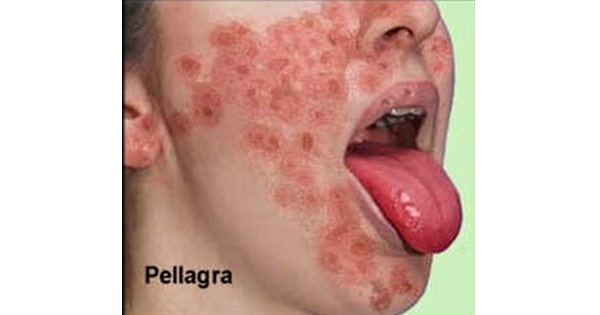
Maize contains the vitamin niacin. Pellagra is a disease that results from niacin deficiency.
Assertion: Consumption of maize may aggravate Pellagra.
Reason: Some strains of maize contains excess of Leucine which interferes in the conversion of Tryptophan into Niacin.
| A |
Both Assertion and Reason are true, and Reason is the correct explanation for Assertion |
|
| B |
Both Assertion and Reason are true, and Reason is not the correct explanation for Assertion |
|
| C |
Assertion is true, but Reason is false |
|
| D |
Assertion is false, but Reason is true |
Maize contains the vitamin niacin. Pellagra is a disease that results from niacin deficiency.
Assertion: Consumption of maize may aggravate Pellagra.
Reason: Some strains of maize contains excess of Leucine which interferes in the conversion of Tryptophan into Niacin.
| A |
Both Assertion and Reason are true, and Reason is the correct explanation for Assertion |
|
| B |
Both Assertion and Reason are true, and Reason is not the correct explanation for Assertion |
|
| C |
Assertion is true, but Reason is false |
|
| D |
Assertion is false, but Reason is true |
Pellagra is caused by Niacin deficiency and anything that interferes in the absorption or production of Niacin will aggravate the condition.

A 10 year old child is suspected of having pellagra because of chronic symptoms including diarrhea, a red scaly rash, and mild cerebellar ataxia. However, his diet is not deficient in protein and he appears to be ingesting adequate amounts of niacin. A sister has a similar problem. Chemical analysis of his urine demonstrates large amounts of free amino acids. Which of the following is the most likely diagnosis?
| A |
Alkaptonuria |
|
| B |
Carcinoid syndrome |
|
| C |
Ehlers-Danlos syndrome |
|
| D |
Hartnup’s disease |
A 10 year old child is suspected of having pellagra because of chronic symptoms including diarrhea, a red scaly rash, and mild cerebellar ataxia. However, his diet is not deficient in protein and he appears to be ingesting adequate amounts of niacin. A sister has a similar problem. Chemical analysis of his urine demonstrates large amounts of free amino acids. Which of the following is the most likely diagnosis?
| A |
Alkaptonuria |
|
| B |
Carcinoid syndrome |
|
| C |
Ehlers-Danlos syndrome |
|
| D |
Hartnup’s disease |
In Niacin deficiency, all of the following are seen except:
| A |
Deafness |
|
| B |
Diarrhea |
|
| C |
Dementia |
|
| D |
Dermatitis |
In Niacin deficiency, all of the following are seen except:
| A |
Deafness |
|
| B |
Diarrhea |
|
| C |
Dementia |
|
| D |
Dermatitis |
Ans. is ‘a’ i.e., Deafness
o Niacin deficiency results in ‘Pellagra’
Pellagra is identified by the presence of three ‘D’s —> Diarrhea, Dementia, Dermatitis
Niacin deficiency causes all except –
| A |
Diarrhea |
|
| B |
Dyspepsia |
|
| C |
Dementia |
|
| D |
Dermatitis |
Niacin deficiency causes all except –
| A |
Diarrhea |
|
| B |
Dyspepsia |
|
| C |
Dementia |
|
| D |
Dermatitis |
Ans. is ‘b’ i.e., Dyspepsia
Niacin deficiency cause –
| A |
Pellagra |
|
| B |
Scurvy |
|
| C |
Rickets |
|
| D |
Lathyrism |
Niacin deficiency cause –
| A |
Pellagra |
|
| B |
Scurvy |
|
| C |
Rickets |
|
| D |
Lathyrism |
Ans. is ‘a’ i.e., Pellagra
Niacin deficiency in a maize-eating population is due to-
| A |
High Tryptophan |
|
| B |
High lsoleucine |
|
| C |
High leucine |
|
| D |
High Phenylalanine |
Niacin deficiency in a maize-eating population is due to-
| A |
High Tryptophan |
|
| B |
High lsoleucine |
|
| C |
High leucine |
|
| D |
High Phenylalanine |
Ans. is ‘c’ i.e., High Leucine
Excess of Leucine interferes in conversion of Tryptophan into Niacin, and aggravates the pallagrogenic action of inake.
Niacin deficiency causes ‑
| A |
Pigmentation |
|
| B |
Diarrhea |
|
| C |
Rash |
|
| D |
Lactic acidosis |
Niacin deficiency causes ‑
| A |
Pigmentation |
|
| B |
Diarrhea |
|
| C |
Rash |
|
| D |
Lactic acidosis |
Ans. is ‘b’ i.e., Diarrhea
- Deficiency of niacin (and tryptophan) causes pellagra which is characterized by 3 Ds, i.e. dermatitis, diarrhea and dementia.
- Pellagra is common in people consuming maize and sorghum (jowar) as their staple foods.
- These two are poor in niacin and tryptophan, and rich in leucin.
- Excess of leucine inhibits the conversion of tryptophan into niacin.