medicoapps masterclass

Anti-Toxicity Drugs Used in Cancer Terapy

ANTI-TOXICITY DRUGS USED IN CANCER THERAPY Q. 1 Acute Gouty arthritis is seen early in treatment following  A Probenecid  B Allopurinol  C Colchicine  D Rasburicase Q. 1 Acute Gouty arthritis is seen early in treatment following  A Probenecid  B Allopurinol  C Colchicine  D Rasburicase Ans. B Explanation: Allopurinol REF: Goodman Gillman manual of pharmacology and therapeutics […]

Anti-Toxicity Drugs Used in Cancer Terapy Read More »

Anti-Toxicity Drugs Used in Cancer Terapy

ANTI-TOXICITY DRUGS USED IN CANCER THERAPY ANTI-TOXICITY DRUGS USED IN CANCER THERAPY TOXICITIES OF ANTI-CANCER DRUGS: 1. Toxicities of alkylating agents: All alkylating agents are myelosuppressive, pulmonary fibrosis, sterility & secondary leukemias (less common with cyclophosphamide). In high dose, all alkylating agents cause veno-occlusive disease in liver (reversed by defibrotide). Alkylating agents Distinctive toxicity Cyclophosphamide

Anti-Toxicity Drugs Used in Cancer Terapy Read More »

Immunostimulants

IMMUNOSTIMULANTS Q. 1 Relative to filgrastim (G-CSF), sargramostim (GM-CSF)  A Has greater  oral bioavailability  B Is more  likely  to cause   thrombocytopenia   C Is more  likely  to elicit  an allergic reaction  D Stimulates production of a wider  variety  of hematopoietic stem  cells Q. 1 Relative to filgrastim (G-CSF), sargramostim (GM-CSF)  A Has greater  oral bioavailability  B

Immunostimulants Read More »

Immunostimulants

IMMUNOSTIMULANTS IMMUNOSTIMULANTS Introduction: Immunostimulants/immunostimulators are substances (drugs & nutrients) stimulating immune system by inducing activation or increasing activity of any of its components. Drugs included: 1. Levamisole: Uses: For treatment of colorectal carcinoma after surgery – In combination with 5-FU. Also for pediculosis treatment. As an antihelminthic drug via stimulation of ganglionic nicotinic receptors. Major

Immunostimulants Read More »

Immunosuppressants

IMMUNOSUPPRESSANTS Q. 1 Post-transplantation hypertension can be caused by: I.  Rejection.         II.  Cyclosporine nephrotoxicity. III.  Renal transplant artery stenosis (RTAS). IV. Recurrent disease in the allograft.  A I,II,III,IV are correct  B I,II,IV are correct.  C I & III are correct  D None of the above is correct. Q. 1 Post-transplantation hypertension can be caused by:

Immunosuppressants Read More »

Immunosuppressants

IMMUNOSUPPRESSANTS IMMUNOSUPPRESSANTS Drugs lowering body’s immunity, including lowering effect of rejection of transplanted organ. Also referred as “anti-rejection” drugs. Drugs included:  Glucocorticoids, Calcineurin inhibitors (Cyclosporine & Tacrolimus), proliferation signal inhibitors (Sirolimus, Everolimus), purine synthesis inhibitor (Mycophenolate mofetil), Antimetabolites (Azathioprine), Cytotoxic agents (Cyclophosphamide, chlorambucil & methotrexate), leflunomide, thalidomide, monoclonal antibodies, co-stimulation inhibitor (Abatacept & belatacept), IL-1

Immunosuppressants Read More »

Urinary Antiseptics

URINARY ANTISEPTICS URINARY ANTISEPTICS Oral drugs rapidly excreted via urine. Suppresses bacterial growth in urinary tract. More effective in acidic urine, – Due to low pH being an independent bacterial growth inhibitor. Important urinary antiseptics: Nitrofurantoin, methenamine mandelate & nalidixic acid. Individual drug description: 1. Nitrofurantoin: Active against most urinary pathogens, except Pseudomonas & Proteus.

Urinary Antiseptics Read More »

Fluoroquinolones

FLUOROQUINOLONES Q. 1 Which drug does not need dose adjustment in a patient with creatinine clearance of  A Ciprofloxacin  B Sparfloxacin  C Lomefloxacin  D Trovafloxacin Q. 1 Which drug does not need dose adjustment in a patient with creatinine clearance of  A Ciprofloxacin  B Sparfloxacin  C Lomefloxacin  D Trovafloxacin Ans. D Explanation: Dose adjustment is

Fluoroquinolones Read More »

Fluoroquinolones

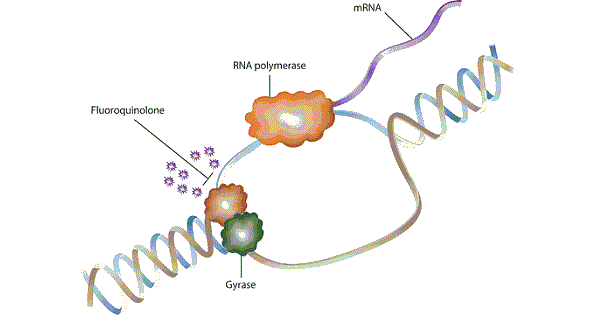
FLUOROQUINOLONES FLUOROQUINOLONES Oral agents. Have long post-antibiotic effect (PAE). MOA: Acts by inhibiting DNA gyrase (topoisomerase II) & topoisomerase IV –> DNA replication inhibition. Classification of fluoroquinolones: Based on spectrum of antibacterial activity:         1st generation: Narrow spectrum; mainly gram-negative. Norfloxacin, lomefloxacin. 2nd generation: Ciprofloxacin & ofloxacin. 3rd generation: More active against gram-positive.

Fluoroquinolones Read More »

👨‍⚕️
Chat Support