
Question
In which condition,the following type of abnormality is seen?
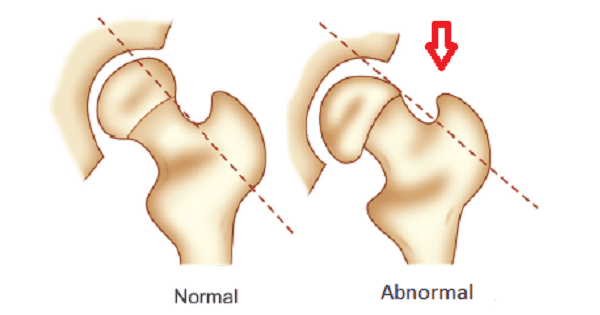
A. Congenital Dislocation of Hip
B. Coxa Valga
C. Genu Valgum
D. Slipped Capital Femoral Epiphysis
Show Answer

|
Correct Answer » D Explanation |
 |
Ans:D. Slipped Capital Femoral Epiphysis.
Trethowan’s Sign is shown in the image.
SLIPPED CAPITAL FEMORAL EPIPHYSIS
- In this condition, the upper femoral epiphysis may get displaced at the growth plate, usually postero-medially, resulting in coxa vara.
CLINICAL FEATURES
- Age: It occurs at puberty (between 12-14 years).
- Sex: It is commoner in boys.
- There is a definite history of trauma in some cases.
- It is commoner in patients with endocrine abnormalities.
Presenting symptoms:
- Pain in the groin, often radiating to the thigh and the knee is the common presenting complaint.
- Limp occurs early and is more constant.
Examination:
- The leg is found to be externally rotated and 1-2 cm short.
- Limitation of hip movements is characteristic – there is limited abduction and internal rotation, with a corresponding increase in adduction and external rotation.
- When the hip is flexed, the knee goes towards the ipsilateral axilla . Muscle bulk may be reduced.
- Trendelenburg’s sign may be positive.
RADIOLOGICAL FEATURES
- On AP view: The growth plate is displaced towards the metaphyseal side. A line drawn along the superior surface of the neck remains superior to the head unlike in a normal hip where it passes bisecting the head –Trethowan’s sign
- On lateral view: The head is angulated on the neck. This can be detected early
