



Hip joint movements
HIP JOINT MOVEMENTS
Motion of the Pelvis on the Femur:
- Whenever the hip joint is weight-bearing, the femur is relatively fixed, and, in fact motion of the hip joint is produced by movement of the pelvis on the femur.
Anterior and Posterior Pelvic Tilt
- Anterior and posterior pelvic tilt are motions of the entire pelvic ring in the sagittal plane around a coronal axis.
- Anterior and posterior tilting of the pelvis on the fixed femur results hip flexion and extension, respectively.


1. Anterior Pelvic Tilt:
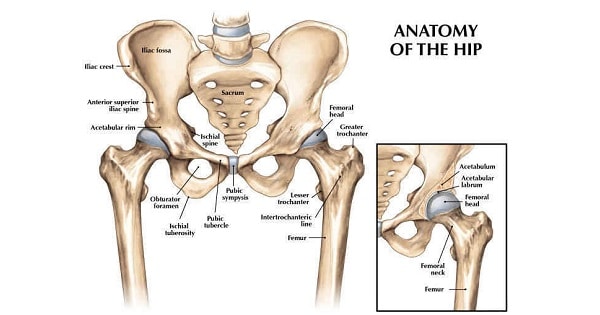
- when ASIS (anterior superior iliac spine) moves anteriorly and inferiorly
- while PSIS (Poserior superior iliac spine) moves anteriorly and superiorly.
- The symphysis pubis moves downward and sacrum moves away from the femur.
2. Posterior Pelvic Tilt:
- when ASIS moves posteriorly and superiorly;
- while PSIS moves posteriorly and inferiorly.
- The symphysis pubis moves upward and sacrum moves towards the femur.
3. Lateral Pelvic Tilt:
- Lateral pelvic tilt is a frontal plane motion of the entire pelvis around an anteroposterior axis.
- If a person stands on the left limb and hikes the pelvis, the left hip joint is being abducted because the medial angle between the femur and a line through the ASISs increases.
- If a person stands on the left leg and drops the pelvis, the left hip joint will adduct because the medial angle formed by the femur and a line through the ASISs will decrease.
Anterior and Posterior Pelvic Rotation:
- Pelvic rotation is motion of the entire pelvic ring in the transverse plane around a vertical axis.
- Occurs in both unilateral and bilateral stance.
1. Forward rotation of the pelvis
- occurs in unilateral stance when the side of the pelvis opposite to the supporting hip joint moves anteriorly.
- Forward rotation of the pelvis produces medial rotation of the supporting hip joint.
2. Backward rotation of the pelvis
- occurs when the side of the pelvis opposite the supporting hip moves posteriorly.
- Posterior rotation of the pelvis produces lateral rotation of the supporting hip joint.
Movements and Muscles
- The movements that can be carried out at the hip joint are listed below, along with the principle muscles responsible for each action:
|
Hip joint Movement |
Chief muscles |
Accessory muscles |
|
Abductors of hip |
|
|
|
Adductors of hip |
|
|
|
Lateral rotators of hip |
|
|
|
Medial rotators of hip |
|
|
|
Extensors |
|
|
|
Flexors |
|
|
- The degree to which flexion at the hip can occur depends on whether the knee is flexed – this relaxes the hamstring muscles, and increases the range of flexion.
- Extension at the hip joint is limited by the joint capsule and the iliofemoral ligament. These structures become taut during extension to limit further movement
- Tensor fasciae latae causes Abduction of hip , Flexion of hip, Extension of knee.
Trendelenburg test
- It measures the stability of hip joint when a person stands on one foot with the opposite foot raised from the ground, as in walking.
- It is mainly dependent on the abductors of hip, chiefly gluteus medius & minimus.
- Normally, when the body weight is supported on one limb, gluteus medius & minimus of the supported side raise the opposite & unsuppoted side of pelvis.
- In positive trendelenburg’s sign, the pelvis sags downwards on unsupported side when a person is standing on one leg.
- This is due to paralysis of abductors of hip (gluteus medius & minimus), which are supplied by superior gluteal nerve.
Exam Question
- Gluteus maximus, piriformis, obturator internus, obturator externus, quadratus femoris, superior gemellus, and inferior gemellus are responsible for external rotation of the hip
- Gluteus medius, gluteus minimus and the deep gluteals are abductors of thighs
- Tensor fasciae latae causes Abduction of hip , Flexion of hip, Extension of knee
- Iliopsoas, rectus femoris, sartorius are muscles causing flexion
- Iliofemoral ligaments limits extension at the hip joint
- Medial rotation and Abduction is caused by Gluteus medius and Gluteus minimus
Don’t Forget to Solve all the previous Year Question asked on Hip joint movements