module Test

Doxycycline

DOXYCYCLINE DOXYCYCLINE: Tetracycline group of drug. Least Nephrotoxic Used in renal failure without dose adjustment. MOA: Inhibits bacterial protein synthesis by binding to 30S ribosomal subunit.  Has bacteriostatic activity against broad range of Gram-positive & Gram-negative bacteria. USES: Indicated for treatment of Rocky Mountain spotted fever, typhus fever, Q fever, rickettsial pox, & tick fevers caused by Rickettsia Respiratory tract infections […]

Doxycycline Read More »

Tetracycline

TETRACYCLINE TETRACYCLINE CLASSIFICATION: Short-acting: Tetracycline Oxytetracycline Intermediate-acting Demeclocycline Lymecycline Long-acting Doxycyclin Minocycline MECHANISM OF ACTION: They are mainly bacteriostatic.  Act by binding to 30 S ribosome of susceptible organism interfering with t-RNA attachment to mRNA acceptor site.  Due to this peptide chain fails to grow & thus protein synthesis is inhibited Carrier involved in active transport of

Tetracycline Read More »

Classification Of Anti-Microbials

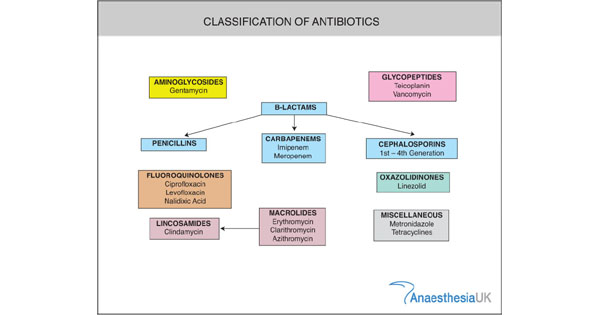
CLASSIFICATION OF ANTI-MICROBIALS CLASSIFICATION OF ANTIMICROBIALS There are many basis for classification of antimicrobial drugs that includes,  CHEMICAL STRUCTURE: Quinolones Nalidixic acid, Norfloxacin, Ciprofloxacin etc Macrolide antibiotics Erythromycin,  Tacrolimus(Fk-506) Roxithromycin,  Azithromycin Polypeptide antibiotics Polymyxin-B,                   Colistin Bacitracin Glycopeptides Vancomycin Teicoplanin Oxazolidinone Linezolid Nitrofuran derivatives Nitrofurantoin Furazolidone Nitroimidazoles

Classification Of Anti-Microbials Read More »

Acetylcholinesterase (Ache) Inhibitors

ACETYLCHOLINESTERASE (AchE) INHIBITORS ACETYLCHOLINESTERASE (AchE) INHIBITORS/ANTI-CHOLINESTERASES Drugs inhibiting Anti-cholinesterase enzyme (Anti-ChE). Thereby, Protects Ach from hydrolysis potentiating cholinergic effects. Increases it’s availability. Prolongs acetylcholine (Ach) actions. DRUGS & CLASSIFICATION: Classified into reversible & irreversible grp. of drugs. Reversible: Do not covalently modify ACh’esterase. Carbamates:  Physostigmine (t)   Neostigmine (q) Pyridostigmine Edrophonium Rivastigmine Donepezil Acridine Tacrine Irreversible

Acetylcholinesterase (Ache) Inhibitors Read More »

Organophosphates Poisoning (Opp)

ORGANOPHOSPHATES POISONING (OPP) INTRODUCTION: Organophosphate compounds are widely used in agricultural sector as PESTICIDES & as chemical war fare. Easily accessible, hence associated with self poisoning 200,000 /500,00 mortality associated self-poisoning with pesticides in rural Asia. 50-70 % in hospital based study. 15-30% in India Suicidal rate with OPC 20.6- 56.3% MECHANISM OF ACTION: Irreversibly

Organophosphates Poisoning (Opp) Read More »

Glaucoma Pharmacological Management

GLAUCOMA PHARMACOLOGICAL MANAGEMENT GLAUCOMA A condition characterised by progressive damage of optic nerve associated with raised intraocular pressure (>21mm/Hg). Raising intraocular tension due to, Excessive production  Less drainage of aqueous humor. Hence, anti-gluacomic drugs act by either, Decreasing secretion (beta-blockers, alpha-2-agonists & carbonic anhydrase inhibitors). Increaseing aqueous humor outflow (Miotics, Dipivefrine & prostoglandins). CLASSIFICATION OF

Glaucoma Pharmacological Management Read More »

Beta Adrenergic Receptor Antagonist / Beta-Blockers

BETA ADRENERGIC RECEPTOR ANTAGONIST / BETA-BLOCKERS CLASSIFICATION: EFFECTS: Beta-blockers have common effects and particular effects. Common effects  The effects of beta-blockers are primarily cardiovascular. Slow heart rate by ↓slope of slow diastolic depolarization and constitute group II of antiarrhythmic drugs.  ↓ heart oxygen requirement,  preventive treatment of angina pectoris. ↓ pathological arterial hypertension, ↓ cardiac output, 

Beta Adrenergic Receptor Antagonist / Beta-Blockers Read More »

Cholinergic Receptors

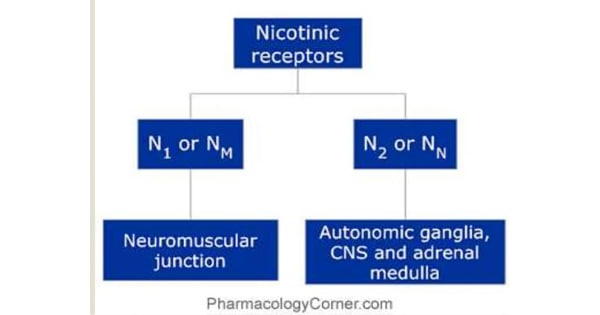
CHOLINERGIC RECEPTORS  TYPES OF CHOLINERGIC RECEPTORS: 2 major types: Nicotinic & muscarinic receptor. NICOTINIC RECEPTOR: NM: Skeletal muscle endplate NN: Ganglionic cells, adrenal medulla, CNS. Acetylcholine acts on nicotinic receptors produces contraction of skeletal muscle. Drugs: D-tubocurarine –  Skeletal muscle relaxant. Acts by competitive inhibition of NM receptors at neuron-muscular junction. Bupropion –  Nicotinic receptor antagonist Clinical: In Myasthenia gravis, antibodies are present against nicotinic receptor. Dry mouth during

Cholinergic Receptors Read More »

Alpha adrenergic receptor

ALPHA ADRENERGIC RECEPTORS INTRODUCTION: Alpha-adrenergic receptor – Are G Protein-Coupled Receptor (GPCR) associated with Gq. Heterotrimeric protein. Generally, α-adrenoceptors exist on peripheral sympathetic nerve terminals. TYPES: Divided into two subtypes α1 & α2. α1 – Mostly found postsynaptically. Consists of three highly homologous subtypes – α1A, α1B, α1D. α2 – Typically sited presynaptically (also occur

Alpha adrenergic receptor Read More »

K+ Sparing Diuretics

K+ SPARING DIURETICS MOA: Acts to indirectly conserve K+ by either of 2 ways, As aldosterone antagonist. Directly inhibit Na+ channels. Site of action: In Distal Tubule (DT) & Collecting Duct (CD) cells in Kidney. CLASSIFICATION: Epithelial Na2+ channel inhibitors. Eg: Amiloride & Triamterene. Aldosterone antagonists. Eg: Spironolactone, Canrenone, Potassium canrenoate & Eplerenone ALDOSTERONE ANTAGONISTS: Pharmacologic antagonists of

K+ Sparing Diuretics Read More »

👨‍⚕️
Chat Support ❌